At a glance
What awaits you
Difficulty
Not yet provided
Route length
Not yet provided
Who is it for
Popular visiting hours
Verified busyness data is not available yet
Best time to visit
JanFebMarAprMayJunJulAugSepOctNovDec
BestGoodHot
7-day forecast
Forecast loads when this section is viewed
About this place
Muzeon HaShomroni HaTov
On the descent from Jerusalem to Jericho, an old roadside inn houses mosaic floors filled with birds, flowers and inscriptions. At the Good Samaritan Museum you can study them at close range, then step outside to the remains of a Byzantine church. The collection brings together the story of a desert road, a Christian parable and the art of communities whose places of worship shared decorative patterns while giving them different meanings.
A museum on the road through the Judean Desert
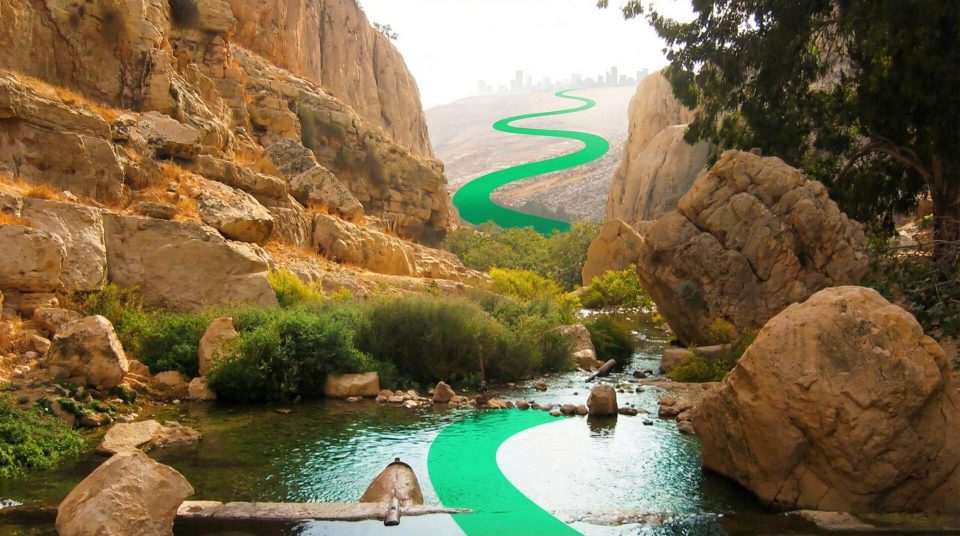
The Good Samaritan Museum, also known by its Hebrew name Muzeon HaShomroni HaTov, stands beside the Jerusalem–Jericho highway. It is east of Jerusalem in the northern Judean Desert, in the West Bank. That location matters when planning a visit: this is the road towards the Jordan Valley, rather than the home of the present-day Samaritan community on Mount Gerizim. Jericho and the northern Dead Sea lie further along possible onward routes. The dry slopes make the choice of a roadside inn easy to understand. Travellers moving between a city in the hills and the hot, low-lying valley needed water, rest and somewhere sheltered to spend the night. Buildings from successive periods accumulated around that practical purpose. Looking beyond the museum walls helps explain why this particular stop endured.
Key dates and details
6th centuryByzantine church and monastery
2009 Mosaic museum opened
6 Rooms in the Ottoman inn
Why the inn bears the Samaritan’s name
The name comes from the parable in the Gospel of Luke. A man travelling from Jerusalem to Jericho is attacked by robbers and left injured. A priest and a Levite pass by, but a Samaritan tends his wounds, takes him to an inn and pays for his care. The story describes compassion that extends beyond the boundaries of one’s own community. By the early Christian centuries, pilgrims were being shown a place associated with the account. A parable, however, is not a report of an incident with an established street address. The ruins demonstrate the existence of a roadside complex and the religious tradition that developed around it. Archaeology cannot establish that the character in the Gospel narrative stayed at this precise spot. Keeping that distinction in mind leaves plenty to explore: the history of how a place became sacred is itself part of the museum’s story.
Three distinct parts of a visit
1
Galleries in the old khan
The indoor display occupies a restored Ottoman khan, or roadside inn. Its stone rooms provide an intimate setting for examining fine details and comparing ornaments. Keep the building’s date separate from the dates of the exhibits: these museum rooms are much younger than most of the floors displayed inside them.
2
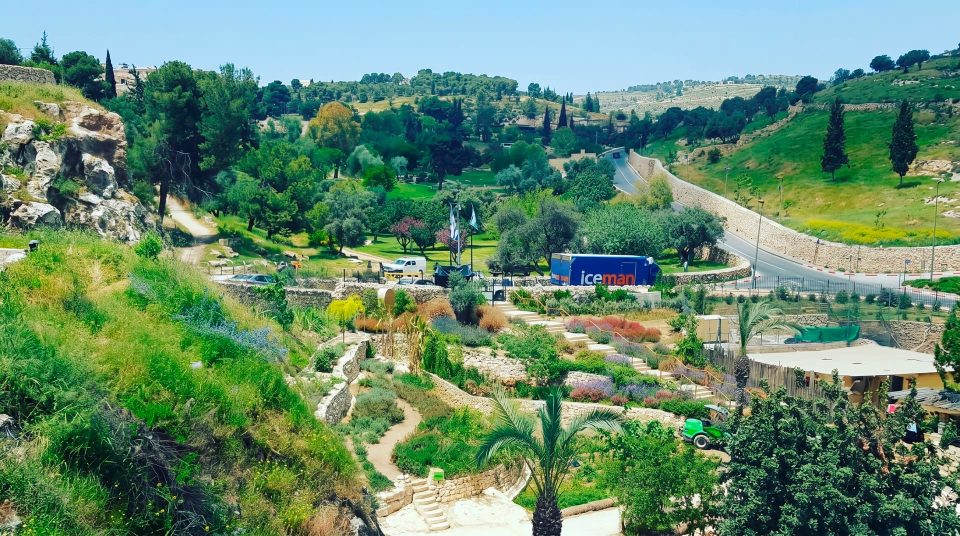
The archaeological courtyard
The open-air collection brings mosaics together with stone finds. Here it is easier to relate a surviving stretch of flooring to the area of an ancient room. Sarcophagi and church furnishings broaden the visit beyond decoration to include burial, worship and the organisation of buildings.
3
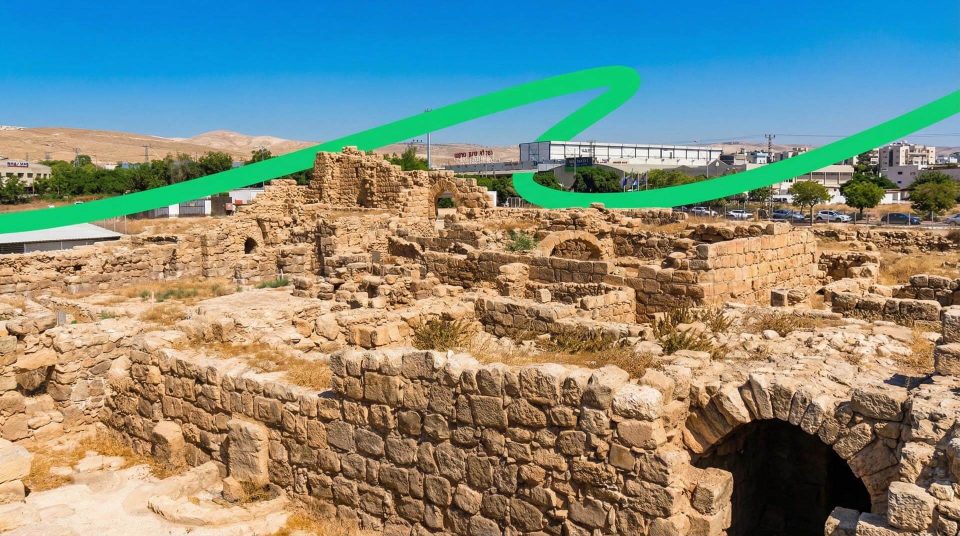
Remains of the Byzantine church
The church belongs to the history of this very site. Its reconstructed space helps convey the layout of a pilgrim stop. Distinguish the walls and plan of the local monument from mosaics brought to the museum from excavations elsewhere.
Mosaic floors from different places of worship
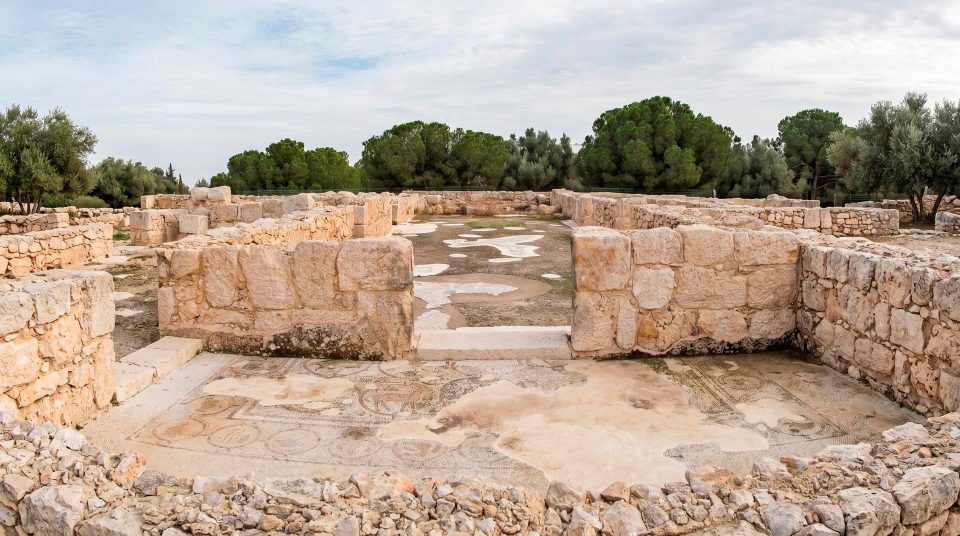
The mosaics at the Good Samaritan Museum come from Christian churches and from Jewish and Samaritan synagogues. Their places of origin include Judea, Samaria and Gaza, and some examples date as far back as the fourth century. Seeing these floors together reveals a shared artistic vocabulary used for different religious patrons. Interlaced geometric bands, plant tendrils and birds occur in more than one tradition. A floor’s religious context is established through its findspot, inscriptions and archaeological setting; a familiar pattern alone cannot identify the community that commissioned it. Start with the label beside each piece. It restores something of the object’s lost setting by identifying the building in which people once walked across it. The comparison then becomes more precise: similar birds or borders can belong to floors with quite different histories.
Looking closely at a floor in a museum
Begin with the overall design. Find the edges of the patterned field, its central motif and the border framing it. Then move your attention to the small pieces of colour that form a bird’s feathers, a petal or a curving stem. Geometric repetition holds a design together across a broad surface, while figures give the eye particular places to pause. Notice where ornament gives way to an inscription. For an ancient visitor, pattern and writing offered different ways of understanding the same interior. With children, try asking how the craftsperson made a rounded shape out of small pieces of stone. It is a useful observation game that requires no prior knowledge of historical periods. Examine the work from the permitted side of the barrier and keep your hands off the surface, even when a detail seems to invite closer inspection.
Details worth comparing
- Geometric fields
- Rhythm and boundaries
- Follow a repeated element all the way to the edge. Its frame shows how the design organised the floor area and where one composition ended.
- Birds and plants
- Figures within ornament
- Compare the birds’ poses, the shapes of leaves and the density of the background. A shared subject does not establish that rooms had the same function or belonged to the same religious community.
- Greek inscriptions
- The language of a text
- Read them alongside the label explaining their provenance. Language was part of the surrounding culture; on its own, it cannot tell you everything about a patron’s religious identity.
- Hebrew and Samaritan inscriptions
- Different writing traditions
- Look closely at the shapes of the letters. The museum includes inscriptions from different communities, pairing similar flooring materials with distinct scripts and religious settings.
Original fragments and reconstructed designs
Stone objects beyond the mosaics
After the colourful floors, spend a little time with the carved stone. Published accounts of the museum’s finds mention sarcophagi, a carved church pulpit, a reliquary and objects used in Byzantine church life. Together they show how many connected elements made up an ancient interior. A mosaic lay underfoot, carving marked architectural divisions, and liturgical objects had roles in worship. Consider each object’s shape and likely position in a building. An upright slab, a column and a horizontal surface performed different tasks, even when displayed close together today. The finds should not all be assigned to a single original church. Some belong to excavations at the museum site, while others were brought from elsewhere. The display labels help distinguish objects recovered locally from those assembled as part of the wider collection.
How the roadside stop changed
- Roman period
Finds at the site predate the Byzantine monastery. They establish earlier use of the location, but do not in themselves connect it to a particular Gospel story.
- Sixth century
A Byzantine monastic complex develops with a church and accommodation for pilgrims. The roadside stop takes on a clearly Christian role alongside its practical purpose.
- Crusader period
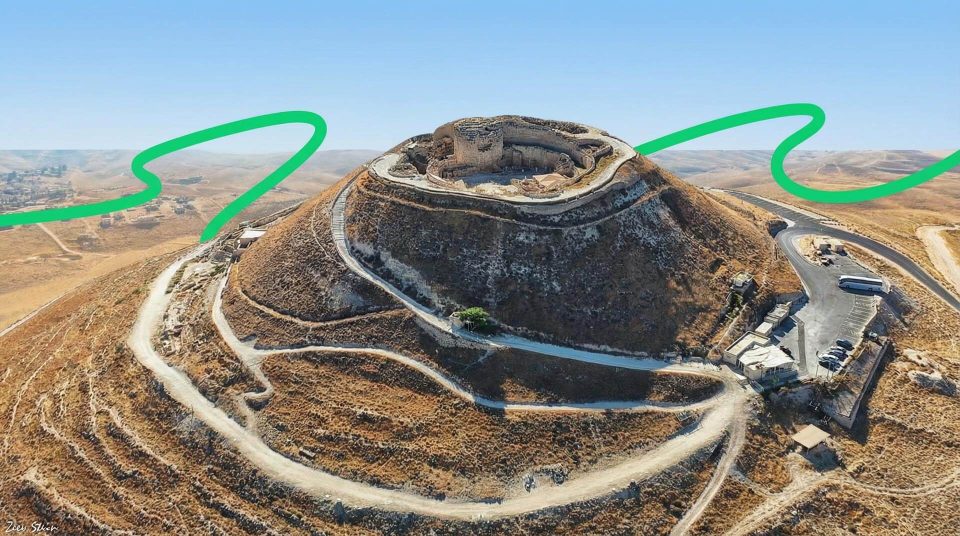
Protecting the road to the Jordan Valley becomes a priority. A fortification known as the Red Castle rises on a neighbouring height. Its remains belong to a separate building from the rooms housing the museum.
- Ottoman period
A khan continues the tradition of serving the road. Its restored building later becomes the indoor section of the museum, giving a new use to the travellers’ accommodation.
- 2009
The mosaic museum opens, combining the archaeological site with a collection of finds from different places of worship.
The church, the courtyard and the Red Castle
Beside the church remains, take a break from comparing patterns and look at the arrangement of the whole site. A place of worship, accommodation along a journey and a defensive position above the road answered different needs of pilgrims. The Red Castle on the neighbouring hill belongs to the Crusader history of protecting the route. Its visible ruins give the museum a wider landscape setting, but their presence does not mean there is an unrestricted route to them from the courtyard. The name of the ascent, Adummim, is associated with the reddish colour of local rocks. The positions of the buildings help explain their functions: the road channels movement, the inn draws travellers to shelter and water, and the high ground offers a view of the approaches. Read those relationships together rather than treating every visible ruin as part of the museum building.
A visit built around observation
- 1
Start with the church on the site
Its plan explains what stood here before the museum. Remember the outline: it will help you separate the site’s own archaeology from objects brought from other excavations.
- 2
Choose a few mosaics to compare
Rather than trying to remember every exhibit, compare a geometric floor, a design with birds and a fragment with an inscription. Use the labels to identify where each one came from.
- 3
Return to the open-air display
After the galleries, notice the scale of the slabs, sarcophagi and architectural details. Compare the coloured surface of a floor with the three-dimensional stone objects around it.
- 4
Allow for the drive as well as the visit
The courtyard and the covered galleries feel quite different on a hot day. Bring water and a hat. Use the designated vehicle access to the complex rather than stopping on the highway shoulder.
A stop towards Jericho or a museum outing in its own right
The museum particularly rewards an interest in late antiquity, pilgrimage and mosaic-making. It offers the chance to compare objects without undertaking a long desert walk. With children, patterns and scripts are usually a more manageable starting point than an attempt to cover the region’s entire religious history. Outdoors, the dry, exposed setting is much more apparent than in the galleries, and milder weather makes it easier to linger in the courtyard. Before setting out, confirm admission arrangements and the entrance you will need. If the museum is part of a journey towards the Dead Sea, give it a distinct place in the day with time to explore the displays. A quick photograph at the gate will miss the collection’s chief interest: the close comparison of floors from different buildings, communities and periods.
Questions about the museum and its mosaics
- Are Muzeon HaShomroni HaTov and the Good Samaritan Museum the same place? Yes. Muzeon HaShomroni HaTov is a transliteration of the Hebrew name; Good Samaritan Museum is its English equivalent. Both refer to the complex beside the road descending from Jerusalem towards Jericho, rather than a museum on Mount Gerizim.
- Is this a museum of the modern Samaritan community? Its main collection consists of mosaics and archaeological objects from the places of worship of several communities. Samaritan heritage appears within that comparative setting. A visit here is different from meeting the community of Kiryat Luza on Mount Gerizim.
- Has the inn in the parable been identified with certainty? No. The name reflects a Christian tradition associating this place with the Gospel story. Archaeology confirms the buildings and the use of the site, but cannot establish a precise location for an episode told as a parable.
- Were all the mosaics found in the museum courtyard? No. The collection brings together finds from different regions and buildings. It also contains reconstructed designs alongside transferred originals. Check each exhibit’s label for its place of origin and the extent of restoration before assuming it survived intact.
- What should children look for? Birds, flowers, repeating shapes and differences between written characters are good starting points. Choose one motif and look for several variations across the displays. This gives children a concrete task without requiring a detailed introduction to ancient history.
- Can the museum be combined with a trip to the Dead Sea? Yes, its roadside location makes that a sensible combination. Plan the driving route separately and confirm admission arrangements for the intended visit. Entry to the museum does not include neighbouring monuments or walks through the surrounding desert.