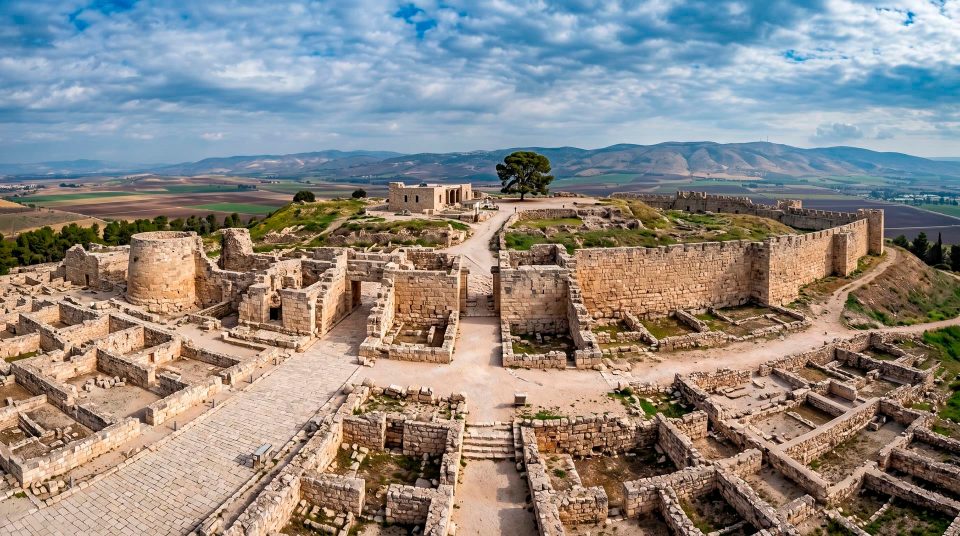
From Mount Gerizim, the narrow valley of Nablus opens below, with Mount Ebal rising opposite. On the summit are the remains of an ancient sanctuary, an octagonal church and houses with an olive press. The Samaritan village of Kiryat Luza lies nearby, below the archaeological summit. This is a place where excavated remains stand alongside a living religious tradition. The mountain is still the Samaritans’ holiest site, a fact that gives particular meaning to the stones and spaces you encounter.
Gerizim and Ebal above the Nablus valley
Mount Gerizim stands in the Samarian highlands of the West Bank, on the southern side of Nablus, the city associated with biblical Shechem. Mount Ebal rises across the valley. Looking down from the summit makes the geography immediately legible: buildings fill the low ground while the slopes rise above them like enclosing walls. Ancient Shechem and the whole of present-day Nablus should not be treated as a single archaeological site. The view helps explain the city’s position, but visiting its monuments requires a separate itinerary. Up on Gerizim, attention shifts to a different scale. There is an open plateau, a steep northern slope falling towards the valley, sparse vegetation and the stone foundations of buildings. A visit moves repeatedly between this broad landscape and small details at your feet. Both are needed to understand the mountain.
Why Gerizim is called the Mount of Blessing
In the biblical account, Gerizim and Ebal are associated with the proclamation of blessings and curses as the Israelites enter Canaan. Gerizim is the mountain of blessing. Its significance for Samaritans extends further: in their faith, this is the place chosen by God for the sanctuary. That belief belongs to a distinct religious tradition and should be presented in the community’s own terms. Descriptions of Gerizim as the world’s oldest or most central mountain express a sacred understanding of space, rather than a geological claim. Recognising the difference makes it easier to explore contrasting interpretations of related texts. Samaritan tradition centres on Gerizim, while Judaism’s central Temple sanctuary is associated with Jerusalem. The surviving ruins record the material history of that difference, including the buildings raised, destroyed and replaced on the summit.
What to look for in the archaeological park
1
The sacred precinct
Walls and platforms mark the area of the ancient religious centre. The overall plan is essential: a single course of stone rarely conveys a temple without a diagram. Some walls visible on the summit belong to later buildings occupying the same ground.
2
The octagonal church
The Byzantine church’s centralised plan differs markedly from a long basilica. Find the sides of its outline and the enclosure surrounding it. That geometry helps show how Christian builders gave architectural form to a commemorative sacred place.
3
The olive press among the houses
Equipment for processing olives survives in a Hellenistic house beside the street below the sacred precinct. The heavy stone machinery shifts attention from religious events to the settlement’s working economy and the people who supported it.
4
The tomb of Sheikh Ghanim
A small domed building stands in the northeastern part of the precinct. It represents another tradition of reverence for the summit. Its surviving height and enclosed form distinguish it clearly from the low foundations of ancient walls nearby.
The Samaritan temple and its destruction
The Samaritan temple on Mount Gerizim was a focus of the community’s religious life, with a settlement developing around the sacred precinct. Its history includes the Hellenistic period and the subsequent conflict with the Hasmoneans. The temple was destroyed under John Hyrcanus in the late second century BCE. Two points matter for visitors: an ancient religious centre stood here, and reverence for the mountain continued after the temple was lost. Do not expect a reconstructed building with complete colonnades or an intact interior to enter. Foundations, the ground plan and the relationships between different areas are the main surviving evidence. Parts of the open summit can seem almost empty until a site plan reveals the sanctuary’s boundaries and the buildings clustered around it. Those low remains then become easier to understand as parts of a substantial religious settlement.
Tracing the outline of the Byzantine church
A Christian church was built on the summit in the fifth century under Emperor Zeno. Its surroundings were strengthened later, under Justinian. Changes in religious control involved bitter conflict, and the church and defensive walls belong to that complicated history. Give the building’s plan a separate pause. Trace the outer outline, locate the centre and distinguish the church itself from the enclosure around it. The octagonal form is found in a number of Byzantine commemorative churches. It produces a very different arrangement from a long hall with parallel rows of columns. Looking only at isolated stones can obscure that distinction. Read the plan first, then match it to the exposed masonry. Against the earlier history of the sanctuary, these foundations mark a separate Christian phase in the summit’s use, rather than another part of the Samaritan temple.
Olive oil and the working life of the settlement
The olive press brings the Hellenistic settlement’s practical economy into view. The excavated installation is described as having a crushing stone and basin, a lever press with weights, and a collecting vat. These belong to successive operations: crushing the fruit, pressing the resulting pulp and collecting the liquid. Look for the distinction between the crushing mechanism and the equipment that applied pressure. They performed separate tasks, although both are easily grouped under the general term “olive press”. Its position in a house beside the street recalls the ordinary economy that sustained a sacred centre. Residents processed harvests, stored supplies and used rooms with no ceremonial purpose. After the monumental enclosures, these working details make the ancient settlement easier to picture. The mechanism offers a direct way into the site’s history even for visitors unfamiliar with its religious background.
Archaeological evidence and religious tradition
The rock associated with Isaac
Samaritan tradition
Samaritans connect a particular place on the summit with Abraham’s test. This is a religious identification; the shape of the rock cannot establish the location of an event in the biblical narrative.
Remains of the octagonal church
An excavated building
The masonry and plan belong to Christian construction in the Byzantine period. They can be described archaeologically, independently of beliefs about events said to have taken place on the mountain.
The tomb of Sheikh Ghanim
Muslim veneration
Local tradition associates the sheikh with Saladin’s army. Distinguish the account of the person believed to be buried here from the domed building that can be observed on the ground.
The Passover sacrifice
A living communal rite
Samaritans continue to perform the rite on the mountain according to their own calendar. It is not a daily park demonstration, and visitors should not assume they may attend or take part without arrangements.
Isaac’s rock and different sacred geographies
Samaritans associate a particular place on the summit with the Binding of Isaac, the biblical account of Abraham’s test. Jewish tradition places the same narrative on Mount Moriah, associated with the Temple Mount in Jerusalem. On Gerizim, visitors encounter a different sacred geography for that shared story. Explain the identification through the beliefs of the people who revere it, rather than turning a walk into an argument about a supposedly proven location. The wording “according to Samaritan tradition” is important. It conveys what the place means while distinguishing religious belief from excavation evidence. Beside the rock, consider how a natural feature can become a focus of memory while buildings around it change over centuries. Treat the place of veneration respectfully even if your own interest is entirely historical or archaeological.
Sheikh Ghanim’s dome above the ancient walls
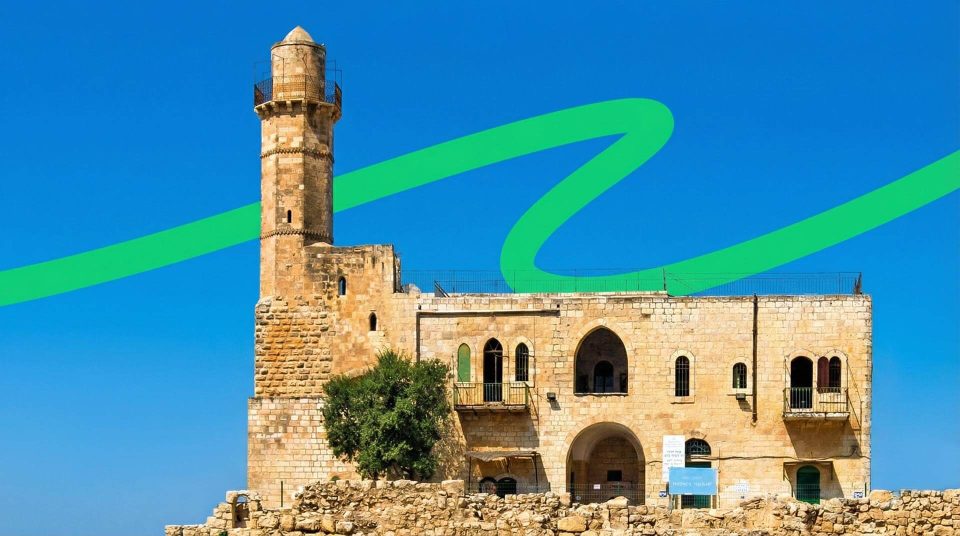
The tomb of Sheikh Ghanim adds a Muslim tradition of veneration to the summit. Local tradition associates the sheikh with Saladin. In the northeastern part of the precinct, the domed building keeps a recognisable silhouette, unlike the fragmentary walls around it, and is an easy visual reference point. Avoid treating all the summit’s religious buildings as one complex from a single period. The Samaritan sanctuary, the Byzantine church and the Muslim shrine have distinct histories and meanings. They can share a photograph without having been built or used at the same time. When composing a picture, include some of the low masonry in front of the dome. The contrast shows how differently the buildings have survived, and keeps the shrine connected to the archaeological landscape around it.
Kiryat Luza: a living community beside the excavations
Kiryat Luza on Mount Gerizim is one of the principal Samaritan communities, alongside Holon. Samaritanism is a distinct religious tradition with its own Pentateuch, script and calendar. The community should not be presented as a museum remnant of a vanished people. Its members lead contemporary lives, using Arabic and modern Hebrew in everyday conversation while maintaining other language forms in worship. Passover on Gerizim is particularly well known for its sacrificial rite, but the Samaritan festival does not automatically fall on the same dates as Jewish Passover. A community visit and a walk through the archaeological park are different experiences. Meetings, access to religious spaces and an introduction through the community’s own museum require separate arrangements. Nearby homes are private residences; their proximity to the excavations does not make every doorway or religious interior open to visitors.
An order that helps the site make sense
1
Begin with the valley
Locate Nablus and Mount Ebal opposite. This gives a clearer sense of Gerizim’s position than a list of elevations and helps connect biblical names with the actual terrain.
2
Study the summit plan
Compare the sacred precinct with the church outline and the later enclosure. Read the diagram before examining the masonry in detail, otherwise buildings of different periods can easily merge into one.
3
Find the signs of everyday work
At the olive press, follow the stages of processing the fruit. It is a good place to talk with children: the heavy stones and collecting vat make the work understandable without specialist vocabulary.
4
Arrange the community visit separately
If you hope to include Kiryat Luza, organise that part of the day independently. An archaeological park ticket or summit tour does not in itself grant access to religious buildings or private premises.
Plan for an exposed summit and a separate access route
Questions about Gerizim and Samaritan tradition
Are Mount Gerizim and Mount Ebal the same mountain? No. They are separate heights on opposite sides of the Nablus valley, with Gerizim to the south of the city. In the biblical narrative, Gerizim is associated with blessings and Ebal with curses as the Israelites enter the land.
Is there an intact Samaritan temple to visit? No. The ancient temple was destroyed. A visit explores the remains of the sacred precinct, later buildings and other structures on the summit. The mountain’s continuing religious importance does not depend on the survival of the temple building.
Why is the rock associated with the Binding of Isaac? That identification belongs to Samaritan tradition. Judaism associates the same biblical account with Mount Moriah. Naming the tradition is essential: the rock’s religious meaning should not be presented as archaeological proof of a particular event.
When was the octagonal church built? It belongs to the Byzantine period and was built in the fifth century under Emperor Zeno. The surrounding complex was fortified later. A site plan and the surviving wall foundations are the best way to recognise its eight-sided form.
Will an ordinary visit include the Passover ceremony? No. It is a specific event in the community’s religious calendar, rather than part of the park’s regular visitor presentation. Attendance, where possible, and the rules of conduct must be agreed separately with the people receiving visitors.
Does park admission include a visit to Kiryat Luza? The neighbouring locations do not form a single visitor programme. The community lives beside the monument, but tours, meetings and access to its premises are arranged separately. Respect residents’ privacy and the rules of places of worship.
Can I simply continue on foot into Nablus? Do not assume so. Access to the summit and a visit to the city need separate planning that takes driving routes and entry conditions into account. A panoramic view of Nablus does not establish an authorised walking descent to its monuments.
Choose your criteriaEach card updates to reflect your preferences and requirements
1 unitUp to 6 guests
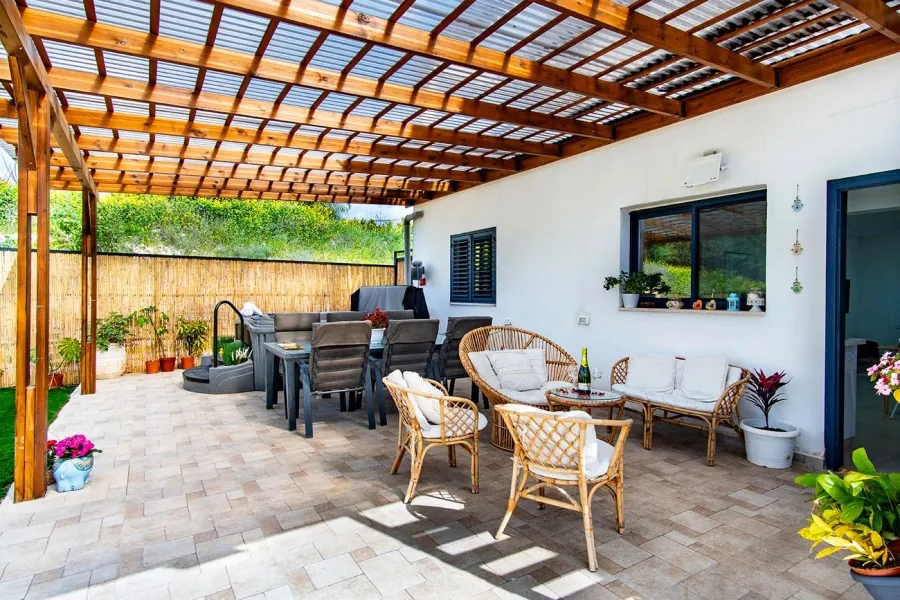
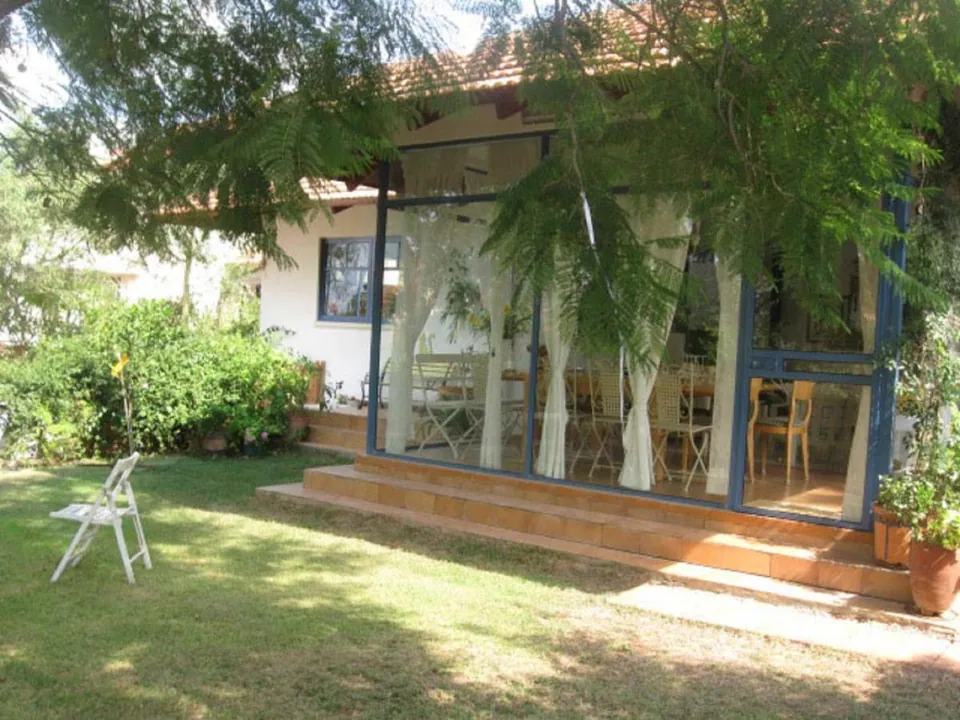
Orlina Rural Hospitality (Tzafon) A pleasant and indulgent vacation awaits you at the "Orlina Rural Hospitality" complex, located in the village of Tzafon. The vacation complex is suitable for hosting couples, families, groups, birthday parties, and bachelorette parties, and offers accommodation in 1 guest apartment. Guests at the complex will enjoy: Double bed with an orthopedic mattress Convertible sofa bed in the living room Air conditioning in every room Dining area Stylish living room Seating area Private balcony with table and chairs Additional bedroom Wardrobe 50-inch TV In the complex's yard: Lawn BBQ Gazebos Trees Decorative flowers Available by prior arrangement and at an additional cost: Pre-booked treatments and massages Dinner by prior arrangement Breakfast arranged with the hosts Event setups for birthdays, marriage proposals, and other special events In Brief What is in the complex: 1 guest apartment
Choose your criteriaEach card updates to reflect your preferences and requirements
4 unitsUp to 20 guests
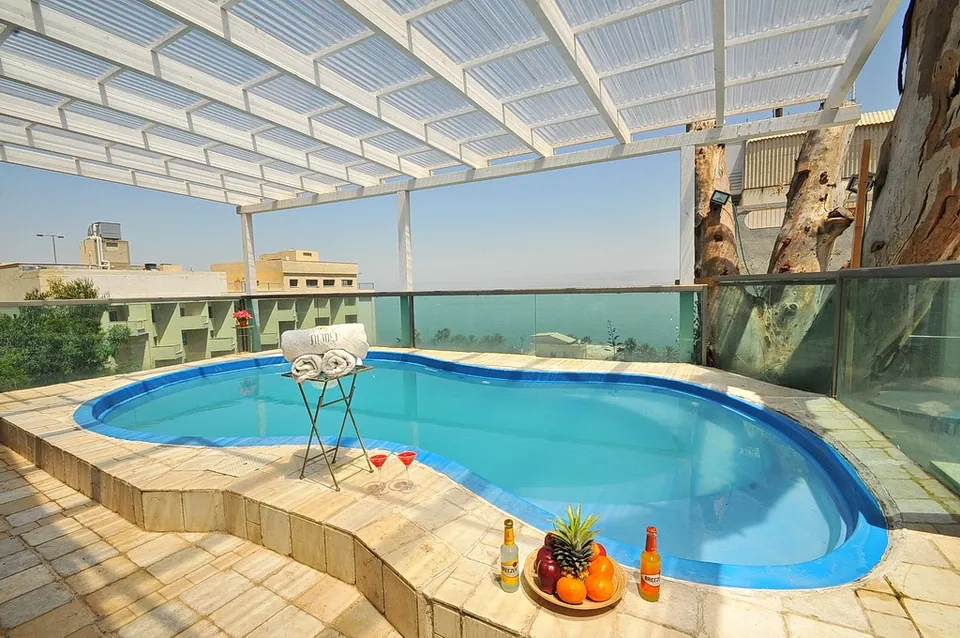
Vacation Village Mitzpe HaNof (Ein Al Asad) – Electric Car Charging Station!
Royal hospitality, sweet treats on the house!
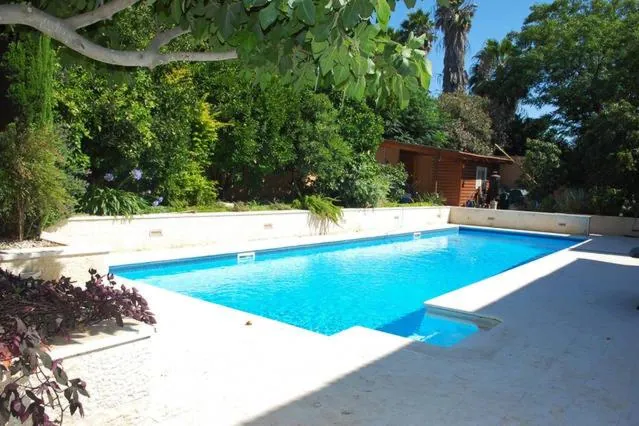
In the heart of the Upper Galilee, in the village of Ein Al Asad, there are 3 cabins and 1 cabin that invite couples and families for a special and pampering stay full of delights. Each room is divided into 2 separate areas.
In each room, you will enjoy:
A comfortable double bed
Air conditioning
Fully equipped kitchenette
Spacious bathroom
Additional bedroom for children
In the shared yard, you will enjoy:
A heated and covered swimming pool
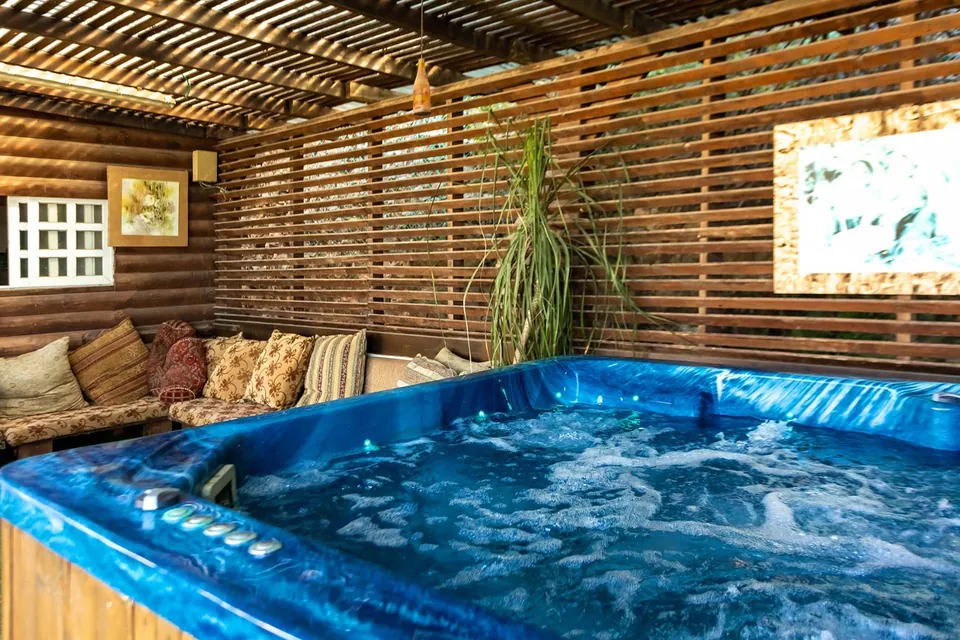
A pampering outdoor spa jacuzzi
Rich garden furniture
Pleasant lighting
A professional barbecue station
Green lawn
Private parking
You can order a variety of breakfast and dinner meals to your cabin – in advance coordination.
In short
What’s in the complex: 1 cabin, 3 cabins.
Choose your criteriaEach card updates to reflect your preferences and requirements
3 unitsUp to 18 guests
Rural Dream (Dalton) – A Special VIP Deal Just for You! Call for Details!
Pampering Jacuzzi with Streams in Each Suite!
Enjoy breakfast, visitor tours in the winery.
In the upper Galilee, in the magical and pleasant Dalton settlement, stands the "Rural Dream" guest house complex, offering breathtaking views of the lush green Galilee landscapes.
The accommodation is tailored for:
Romantic couples
Families with children
Groups of friends
Parties for any occasion
The complex features 3 family cabins, with additional nearby amenities.
In each unit, you’ll enjoy:
Pampering Jacuzzi with streams
Comfortable bed
Bathroom
Small kitchenette
Dining and sitting area
TV connected to cable channels
In the shared yard, you’ll enjoy:
A relaxing and clear swimming pool
A large and well-kept lawn
Garden furniture sets
Lighting for late evening hours
Private, adjacent parking
With prior coordination with the owners, you can order:
Breakfast
Dinner
A variety of professional massages
**Please Note: No BBQ allowed on Shabbat!**
Quick Overview
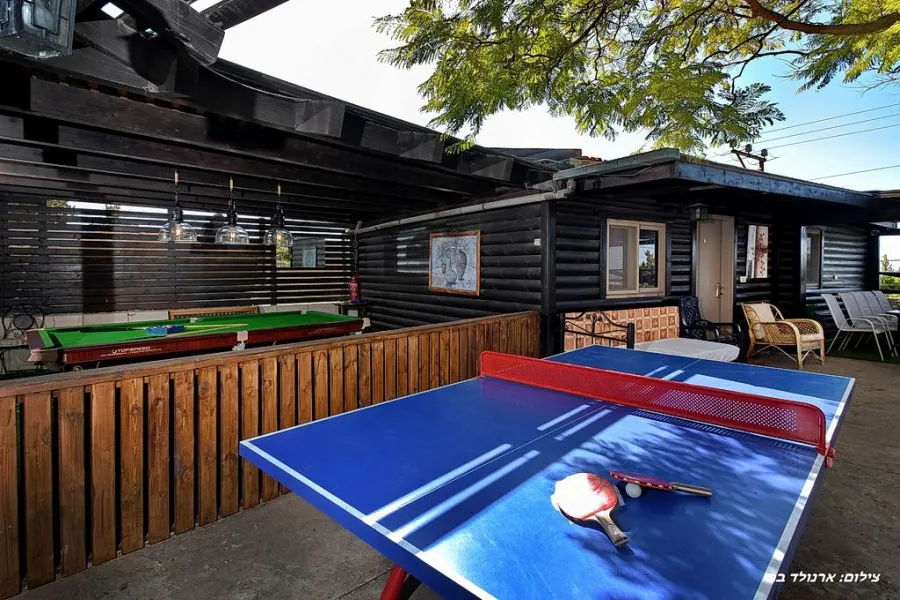
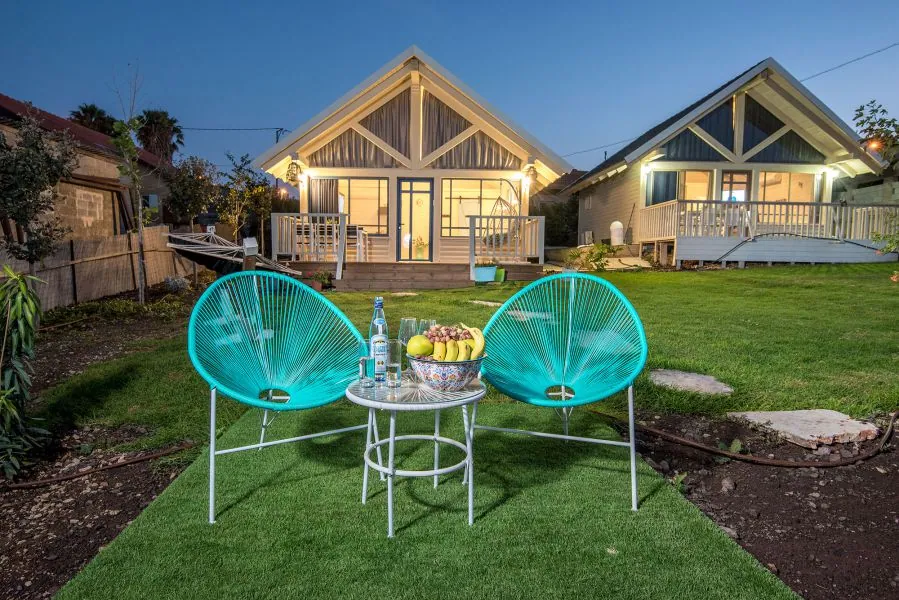
What’s in the complex: 3 wooden cabins.