At a glance
What awaits you
Visit duration
Not yet provided
Difficulty
Not yet provided
Route length
Not yet provided
Who is it for
Popular visiting hours
Verified busyness data is not available yet
Best time to visit
JanFebMarAprMayJunJulAugSepOctNovDec
BestGoodHot
7-day forecast
Forecast loads when this section is viewed
About this place
Bet Guvrin National Park
At Beit Guvrin, you can walk over an entire working world without knowing it is beneath your feet. Dovecotes, cisterns, olive presses and burial chambers were cut into the low hills. The bell caves open into vast, light-filled spaces, while a Roman arena lies across the road. Beit Guvrin–Maresha National Park, also written Bet Guvrin, brings together two ancient towns and shows how soft rock became building material, a place of work and a setting for remembrance.
Maresha to the south, Beit Guvrin to the north
The park lies east of Kiryat Gat in the Shephelah, the belt of low hills between the coastal plain and the Judean Mountains. Road 35 separates its two main parts. The southern section centres on Tel Maresha and the underground complexes; the northern section contains later Beit Guvrin, known in the Roman period as Eleutheropolis. Keep that distinction in mind when planning: the caves and amphitheatre are not arranged around a single square. Even the southern section consists of several groups of sites with above-ground walks between them. A car can shorten some of the links between parking areas, but exploring each chamber still involves getting out and walking. Arriving solely for one famous cave hall can mean missing how the wider settlement was organised.
Why the hills are hollow
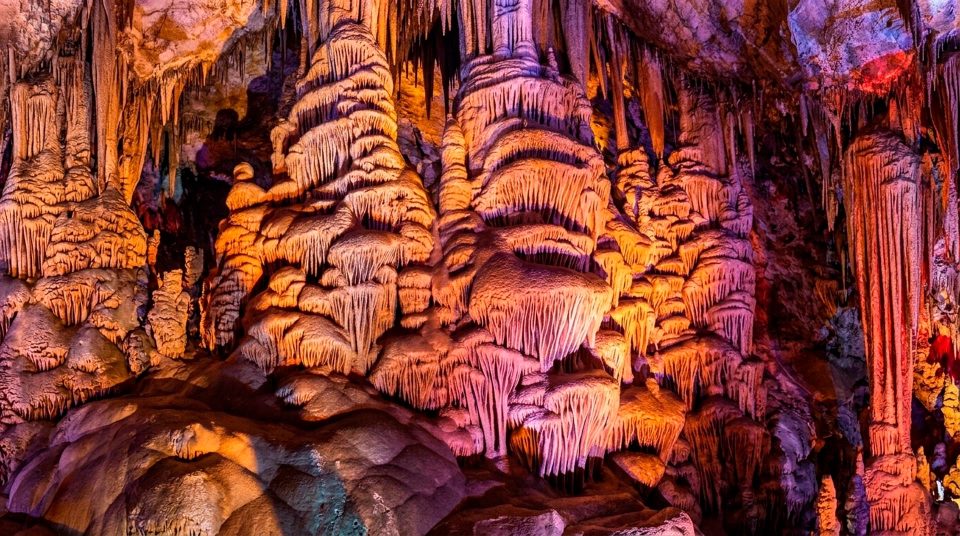
A hard crust of local rock overlies softer chalk that can be cut relatively easily. People exploited that difference to quarry building blocks and create underground rooms. A working could change its purpose: an excavated hollow might later house equipment, store water or become a dovecote. Look for regular niches, steps and tool marks rather than expecting natural stalactites. The caves of Maresha record human labour. Some rooms show a careful use of limited space; elsewhere, the cutters aimed for a regular shape and neatly arranged details. Much of that activity is almost invisible from the surface. Descending reveals a complex, organised environment beneath what initially appears to be a simple rural landscape.
Different caves served different purposes
1
The bell caves
The bell caves at Beit Guvrin reveal the scale of former quarries. Light falls through an opening above onto walls that widen towards the bottom. Their shape reflects the extraction of softer rock beneath the hard surface layer. Some neighbouring workings join together. Look at the rock bridges left between them and the direction of cutting to understand the size of these production spaces.
2
Maresha’s working complexes
Low passages, stairs, containers and installations show the everyday uses of the underground level. Their connection with houses above matters. Residents expanded the usable space beneath their buildings; an entire town did not move into one shared underground hall.
3
Burial chambers
Niches along the walls held burials. Paintings and inscriptions reflect the beliefs and family connections of Hellenistic Maresha's inhabitants. Read their layouts and decoration separately from the industrial caves: similar rock served a very different aspect of life.
The columbarium and its rows of working niches
In the underground columbarium, repeated small recesses immediately catch the eye. These niches were used to breed pigeons. The birds provided food, their droppings were used as fertiliser, and some pigeons were used in religious rituals. The regular rows suggest an organised enterprise requiring upkeep and a market for its products. Here, columbarium means a dovecote. The funerary meaning familiar to many modern readers does not apply to this particular structure. Notice the height of the rows and the care with which the niches were cut. Their arrangement along the walls of existing hollows also reveals the reuse of underground spaces. The repetition of a small feature makes the scale of the room, and the work involved in maintaining it, easier to grasp than a general account of the ancient economy.
The olive press, from fruit to oil
Underground olive presses reveal distinct stages of production. First, a heavy stone crushed the olives in a round stone basin. The resulting pulp was placed in woven containers and pressed beneath a beam weighted with stones. Liquid drained into prepared collecting hollows. Look for that sequence: crushing and pressing were different operations, even though casual descriptions often use one word for both. Olive-oil production was an important part of Hellenistic Maresha's economy. Installing equipment in a rock-cut chamber made use of space that had already been created below ground. Heavy stone components, grooves in the walls and collecting basins survive better than timber and basketry, so some parts of the mechanism need to be reconstructed in the mind. This is a good place to pause with children and discuss each component's purpose from its shape.
The Sidonian caves and their reconstructed paintings
An inscription in the burial cave of Apollophanes names the leader of Maresha's Sidonian community. It connects the monument with identifiable people in a multilingual Hellenistic town. Real and mythological animals appear above the burial niches, and a nearby chamber is known as the Cave of the Musicians. The colourful scenes visitors see are reconstructions of ancient paintings. That distinction matters: they help explain the original composition, but their bright surfaces should not be presented as untouched ancient paint. Mythological figures, including Cerberus guarding the underworld, express ideas about death and the journey beyond it. Sidonians, Greeks and Idumeans left overlapping cultural traces here. The funerary decoration is especially revealing of the varied backgrounds of Maresha's population.
Cisterns and the underground Maze
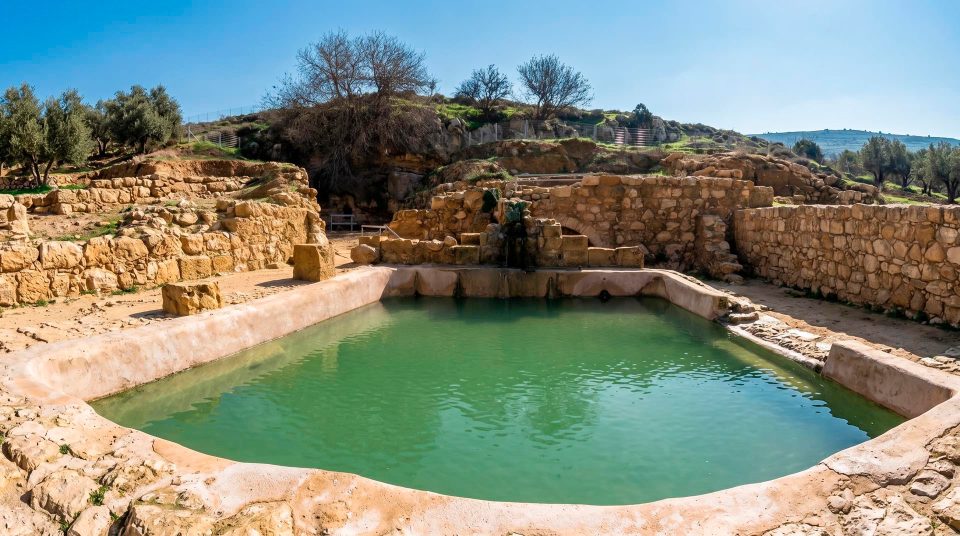
In the rock-cut complexes, notice where stairways lead and how the water-storage spaces are shaped. Capturing rainwater was essential to a settlement on these hills. Joined cavities and passages, including the complex known as the Maze, show how underground space expanded over time. The name may suggest a find-your-way-out attraction, but this is an archaeological system with a defined visitor route. Approach it as a house seen in section: where did people descend, where were reserves kept, and which opening was made later? Do not explore side holes or undeveloped workings independently. Many cavities in the park lie outside the visitor route. Being close to a cave that is open to visitors does not make the next opening safe to enter.
A twentieth-century inscription in an ancient chamber
How the main settlement shifted
- Iron Age
Maresha was a town of the Kingdom of Judah. Later buildings and underground working spaces developed from that earlier settlement.
- Hellenistic period
The town had a mixed population and established industries. Its working complexes and painted burial caves belong to this cultural setting.
- 40 BCE
The Parthians destroyed Maresha. Beit Guvrin took over its role as the principal local settlement.
- Second century CE
A Roman amphitheatre was built at Beit Guvrin. Public spectacles became part of life in the new centre.
- 200 CE
Beit Guvrin received city status and the name Eleutheropolis. Its Roman and Byzantine remains are concentrated in the northern part of the park.
- 2014
The caves of Maresha and Beit Guvrin were inscribed on UNESCO's World Heritage List. Their significance lies in the long history of human use of underground space.
The northern town above ground
1
The amphitheatre
The Roman amphitheatre at Beit Guvrin has an arena once encircled by seating. Vaulted structures underneath supported the load and allowed people to circulate. Its elliptical arena distinguishes it from a semicircular theatre. View the surviving fabric and restoration together, rather than expecting an entirely untouched ancient building.
2
Fortress and church
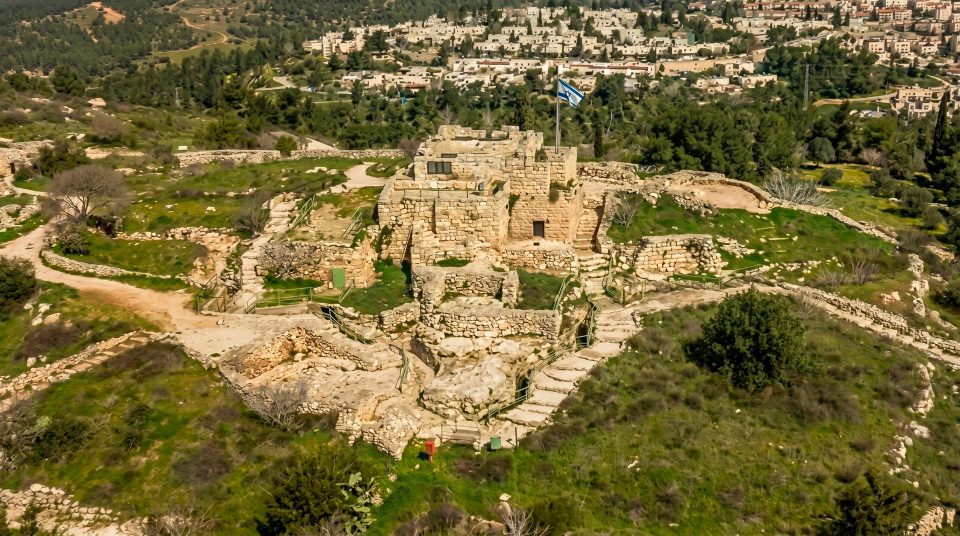
The Crusaders reused remains of the earlier town when building their fortified complex. It contains church architecture and reused classical pieces. Look at how newer walls sit on earlier structures, instead of searching for a pure example of a single period.
3
Roman baths
The bath complex introduces another aspect of urban life. Vaults, rooms and the overall plan suggest a public building with several different functions. After Maresha's smaller working caves, the scale of the northern town changes the experience considerably.
A separate stop at the Church of Saint Anne
The ruins of the Church of Saint Anne stand in the southern section, also known by the Arabic name Sandahanna. The surviving apse is prominent against the open hills. The building had a Byzantine phase and was rebuilt in the Crusader period. After underground rooms with very different functions, it offers a useful example of a religious space above ground. The church is also linked with the mound's former name, Tell Sandahanna. Do not confuse these ruins with the church remains in the northern fortress: they occupy different parts of this large park. The exposed ground around the apse is another reminder that a Beit Guvrin visit alternates descents with walks across the hills, even when the caves are your main reason for coming.
Choosing the focus of a single visit
- Large underground spaces
- Spaces created by quarrying
- Choose the bell caves to appreciate quarry shapes, light entering through openings above and the sheer scale of the cutting.
- Everyday ancient life
- Maresha’s working economy
- The columbarium, olive press and cisterns connect rooms with food, agriculture and stored water. Compare the installations rather than viewing each in isolation.
- Art and belief
- The Sidonian caves
- The burial chambers explore family memory and Hellenistic culture. Read the compositions with an understanding that the visible paintings have been reconstructed.
- Roman urban life
- Beit Guvrin and Eleutheropolis
- The amphitheatre, baths and fortress require a visit to the northern section. Plan a separate transfer via the proper approaches, rather than an improvised crossing of the main road.
Stairs and surface walks set the pace
Explore the southern section in small groups of sites around the parking areas, adding surface walks where they serve your chosen stops. In hot weather, a chamber's cool feel can be deceptive: an exposed stretch across the hills may separate it from the next entrance. Spring brings green slopes and a landscape interest of its own, but rain can leave stone steps slippery. In darker passages, give your eyes time to adjust. A close group moves more slowly on stairs than on level ground above. If someone needs a step-free visit, identify suitable individual sites and approaches rather than relying on a general description of the park. Before travelling, check which caves are available, how to move between sections and the entry arrangements. Once inside, give each room time. Its layout reveals more than simply collecting every name on the map.
Questions about the caves and the two ancient towns
- Did the caves form naturally? The main complexes shown to visitors were cut by people in the soft rock. They include quarries, cisterns, working rooms and burial chambers. Look for tool marks and evidence of each space's function, rather than natural stalactites.
- Are Maresha and Beit Guvrin the same ancient town? They are connected but distinct settlements. Maresha occupies the southern part of the park; later Beit Guvrin and its amphitheatre lie to the north. After Maresha was destroyed, Beit Guvrin became the area's principal settlement.
- Were people buried in the columbarium? That is not the function of the ancient dovecote shown here. Its niches were used for breeding birds. The park's burial chambers are separate monuments with their own layouts and decoration. Do not apply the modern funerary sense of columbarium to the dovecote.
- Are the bright wall paintings original? The visible paintings in the Sidonian caves are reconstructions. They reproduce the subjects of ancient paintings and help explain the funerary compositions. Their bright surfaces should not be mistaken for undisturbed paint surviving from Hellenistic times.
- Is the amphitheatre beside the bell caves? It is in the northern section, across Road 35. Plan a separate transfer between the two parts using the permitted approaches. Do not assume there is a short, direct pedestrian crossing over the main road from the caves to the arena.
- Can I take a stroller through every underground site? There is no single step-free route through all the caves. Descents, steps and passages vary. For a stroller or a visitor with limited mobility, choose specific suitable sites in advance using information from the park administration.
- Should I enter every cave in one visit? You do not need to. A bell-shaped quarry, a dovecote and a painted burial chamber offer different subjects even on a shorter visit. Choose contrasting sites and examine them carefully, rather than repeating similar descents just to increase the total.