At a glance
What awaits you
Difficulty
Not yet provided
Route length
Not yet provided
Who is it for
Popular visiting hours
Verified busyness data is not available yet
Best time to visit
JanFebMarAprMayJunJulAugSepOctNovDec
BestGoodHot
5-day forecast
Forecast loads when this section is viewed
About this place
Ein Hemed National Park
At Ein Hemed, a path follows the water until the stone courtyard of Aqua Bella appears behind the trees. The springs explain why a medieval farmstead was established in this hollow of the Judean Hills. Today, small pools, lawns and vaulted rooms make an unhurried visit possible. Look beyond the greenery, though, and the park becomes more interesting: its old agricultural buildings and the modern system sustaining the stream reveal how this waterside landscape works.
A hollow beside the Hemed interchange
Ein Hemed lies west of Jerusalem, beside the Hemed interchange on Highway 1. This part of the Judean Hills contains a hollow with springs and the bed of Nahal Kesalon. Proximity to the highway makes the park a practical stop in its own right on the way to the city, but it has a character quite separate from a roadside rest area. Inside, trees, pools and a substantial stone building quickly take over your attention. You can centre the visit on medieval architecture or spend longer following the streambed. Unlike the panoramic hills nearby, Ein Hemed National Park directs the eye downwards, towards water and walls. Beneath the general impression of a green park lies the history of an agricultural estate for which the springs were a valuable advantage.
The water is supported by a recirculating system
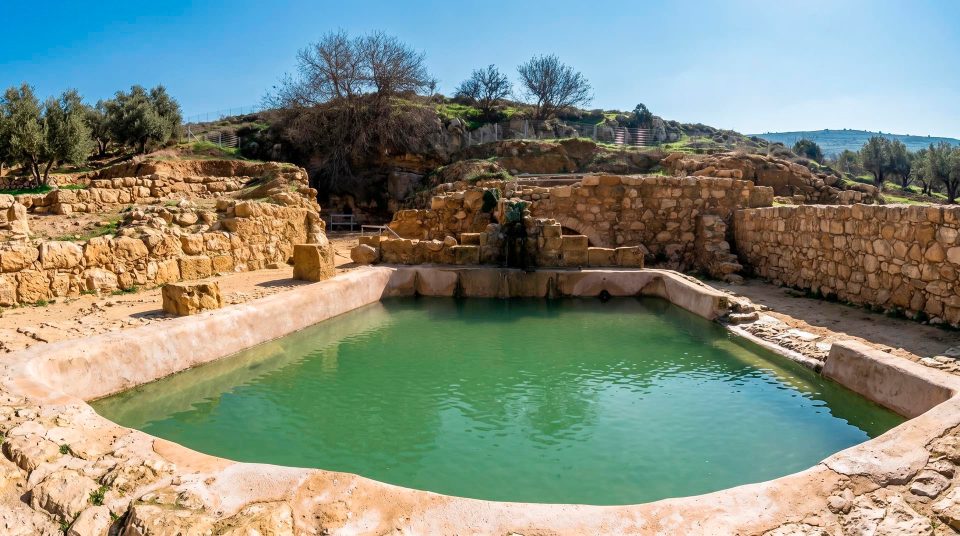
A walk beside Nahal Kesalon at Ein Hemed needs one important explanation. An engineered system helps sustain the water landscape by collecting spring water and returning it to the head of the flow. The Israel Nature and Parks Authority describes this recirculation as a way to prevent drying during winters with little rain and periods of drought. The chain of small pools should therefore not be taken as evidence of a permanently strong natural stream. The springs, stone-lined water features and modern support system work together. From the bank, follow where water is held and how it passes to the next level. The system helps maintain the park’s landscape. Clear-looking water, however, says nothing about whether it is safe to drink or whether entering it is permitted.
Four different stories within the park landscape
1
The fortified farmstead
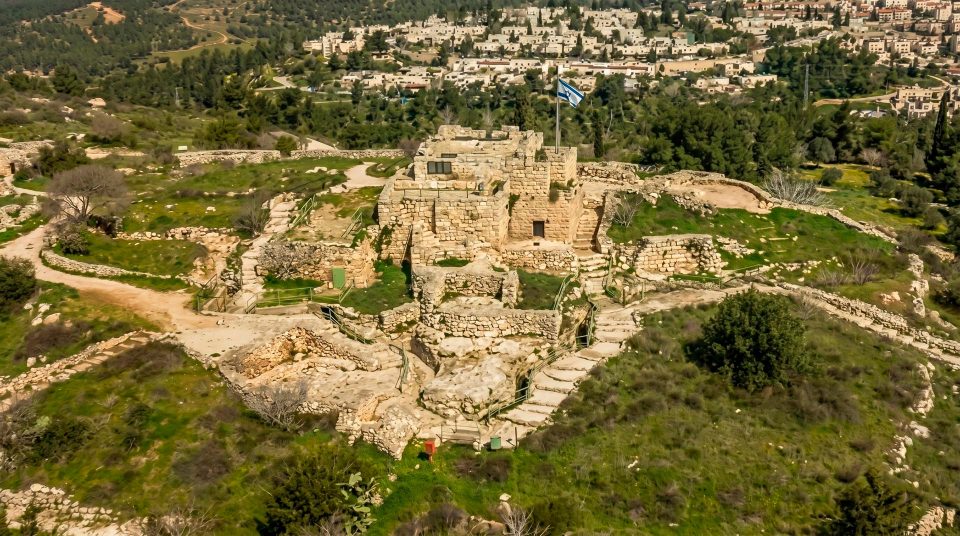
The main historical building stands in the southern part of the park. Its stone enclosure, courtyard and vaulted spaces suggest a medieval structure combining protection with practical agricultural functions.
2
The streambed and small pools
The water features reveal the difference between a natural spring and a designed park. Look at the connections between pools, the direction of flow and the contrast between damp banks and adjoining lawns.
3
Trees and the old cemetery
South of the fortified building are an associated nature reserve and Muslim cemetery. Respect for the sacred site helped preserve oaks and terebinths. This is a quieter historical landscape, distinct from the recreation grounds; access to the reserve should be planned separately rather than assumed to continue directly from the park.
4
The burial cave
The official itinerary includes a circular path to a First Temple-period burial cave south of the streambed. It represents an earlier chapter than the medieval farmstead. Follow the designated route for viewing rather than treating cavities as places to enter freely.
Aqua Bella on the medieval road
The Latin name Aqua Bella is usually translated as “beautiful water”, an apt description of what first made the place valuable. It stood on the route from the coastal plain to Jerusalem through Bab al-Wad, a corridor used before the Middle Ages as well. Water beside the road improved the site’s prospects both for farming and as a stopping place for travellers. The surviving building is associated with the Knights Hospitaller and the Crusader period. The official description is cautious about its precise function, presenting it as a fortified building that probably served a farm. That is more accurate than imagining a vast knights’ castle. Aqua Bella’s scale and layout support the idea of a protected farmstead with organised internal space. They do not justify importing the appearance of hilltop fortresses such as Belvoir into this small valley.
Reading the fortified building from the inside
The farmstead’s most expressive features are its vaults, thick masonry and the relationship between enclosed rooms and the open courtyard. If the interior is accessible during your visit, begin with the overall plan. Locate the courtyard, openings and halls before examining the overhead stonework. An arch distributes weight, while a massive wall makes the boundary between courtyard and room feel substantial. Even without knowing architectural terminology, the skill of the masons is visible. Popular accounts sometimes give every hall a definite role, such as knights’ sleeping quarters, a pilgrims’ dining room or a kitchen. Such detail needs research or on-site interpretation to support it. A safer reading follows the surviving plan of a fortified agricultural establishment. There is a quieter visual pleasure too: framed by stone openings, the park’s greenery looks different from the view along an open path.
Historical landmarks at Aqua Bella
- The First Temple period
The burial cave reached by a separate trail is attributed to this period. It belongs to another chapter of the site’s history and is not part of the Crusader buildings.
- The Crusader period
The surviving fortified farmstead, associated with the Hospitallers, takes shape. The springs and road to Jerusalem define its agricultural value. The Latin name Aqua Bella preserves the memory of this era.
- 1968
The national park and nature reserve are established. The historic building and waterside landscape become part of a protected setting adapted for walking and recreation.
Old trees and autumn leaves
Greenery beside the water has a different character from vegetation on the dry, open slopes of the Judean Hills. In autumn, leaves change colour and collect under the trees, giving the stone building a different backdrop. Seasonal leaf fall is a recognised feature of the park. Ein Hemed also rewards attention beyond autumn photography. In the cool, wet season, the streambed, fresh growth and seasonal flowers become more prominent; the official plant description includes lesser celandine. The reserve beside the cemetery has its own story. Respect for the graves and the tomb of Sheikh Abdullah helped preserve the trees. View trunks and crowns with due regard for the burial ground, checking the appropriate access rather than assuming a route through from the park. A broad trunk does not establish a tree’s precise age, and an attractive description such as “centuries-old” cannot substitute for evidence.
Deciding where to spend your time
- The medieval farmstead
- Courtyard, openings and vaults
- Allow time to explore the building in sequence. Its exterior establishes the outline; the interior makes the organisation of the working spaces easier to understand.
- Water and engineering
- Springs and recirculation
- Trace the relationship between the streambed and the pools. Distinguish natural spring supply from the system maintaining circulation, especially after a dry season.
- A visit with children
- Banks, lawns and play equipment
- Alternate short observations with rest. An adult should remain close to a child near water, even when most of the walk follows a developed recreation area.
- A quieter visit
- Trees and the historic setting
- Give attention to the trees and the historic landscape associated with the cemetery, respecting its purpose and checking the appropriate access. An empty or silent park on a particular day cannot be guaranteed.
A family day built around small discoveries
There is no need to make every stop at Ein Hemed a history lesson. A child can follow water from one pool to the next or compare a curved vault with a flat wall. Adults may find these observations more interesting when they are linked to the farmstead’s practical tasks: storing food, cultivating land and using the springs. Lawns, picnic tables and play equipment allow time to be shared between exploring and resting, rather than spending the whole visit beside a single building. Set up a picnic in the designated area and leave paths along the bank clear. Do not climb historic walls for a group photograph. The wish to look closely at the water is best satisfied from the path: stone edges and damp patches can be slippery.
How the visit changes with the seasons
1
An autumn day
A good time to watch the foliage and photograph the farmstead framed by trees. Colour changes gradually and depends on weather, so there is no single compulsory week for a visit.
2
Winter and spring
The wetter season renews greenery and seasonal flowers. During heavy rain, conditions in the streambed can change quickly. Moving close to the water’s edge in such weather offers little reward to justify the risk.
3
The warm, dry season
Shade allows walking to be interspersed with rests, but areas near the building and on its approaches may be exposed to the sun. Springs and recirculation do not make the park a guaranteed destination for water-based recreation.
Planning the practical details
- 1
Navigate to the park
Look for En Hemed National Park, an official spelling used for Ein Hemed, beside the Hemed interchange on Highway 1. The entrance lies south of the interchange. Use actual traffic conditions when planning: a short map distance does not predict driving time on the approaches to Jerusalem.
- 2
Make a brief check before travelling
Confirm tickets, admission arrangements, entry times and which parts of the farmstead can be visited. Old schedules in travel articles are unsuitable for this. Use the park’s official reservation system if advance registration is required for your intended visit.
- 3
Check accessibility for the specific route
Play equipment and certain developed areas are described as adapted for people with disabilities. This does not establish access to every historic room or path. If a step-free route or space for a wheelchair or pushchair matters, plan the particular section you need.
- 4
Pack for time beside the streambed
Bring shoes with a good grip, drinking water and a bag for your litter. Keep picnic supplies compact enough to carry away easily. Park rules determine whether fires, entry into the water or other activities are permitted.
Nearby places bring the differences into focus
For another stop, Abu Ghosh offers medieval church heritage, while Castel focuses on the fighting for the road to Jerusalem. Aqua Bella reveals the agricultural life of the same mountain corridor: here, water, land and the route between the coast and city take centre stage. Castel looks down onto the road; at Ein Hemed, the walk stays near the streambed. Each has its own story, and they should not be merged into a single “Crusader park”. If the day is devoted to Ein Hemed itself, return to the water after exploring the building. A second look picks up easily missed details: the drop between pools, the boundary between shade and sunlight, and stone walls appearing through gaps in the trees.
Questions about Ein Hemed
- Are Ein Hemed and Aqua Bella the same place? Yes. Aqua Bella is the historic Latin name associated with the Crusader period. Today it often refers specifically to the fortified farmstead inside Ein Hemed National Park, beside the Hemed interchange on Highway 1.
- Is the water flow entirely natural? The park has springs, but a recirculating system supports the visible flow. It collects water and returns it to the beginning of the channel, helping maintain the waterside landscape during dry periods.
- Should I come here specifically to swim? Plan for a walk, the farmstead and time beside the water instead. The presence of pools does not establish permission to swim. Check with management and on-site signs for the rules governing contact with the water.
- What survives from the Crusader period? A fortified stone building with a courtyard, openings and vaulted rooms. It is associated with the Knights Hospitaller; the official description cautiously identifies a probable agricultural role as a farmstead.
- Is an autumn visit worthwhile without children? Yes. Falling leaves, trees beside the channel and stone vaults provide subjects for a walk and photography in their own right. Family facilities are only one aspect of the park, rather than the whole reason to visit.
- Are all paths and halls accessible to wheelchairs or pushchairs? Full access cannot be promised. Developed recreation areas, the cave trail and the medieval building have different conditions. Visitors with limited mobility need a plan for the particular sections they can use.
- How does Ein Hemed differ from Castel? Ein Hemed centres on a waterside landscape and medieval farmstead in a hollow. Castel’s main subjects are commanding high ground, defences and remembrance of the fighting for the Jerusalem road. Their entrances and walking routes are separate.
Sources
History
The burial cave reached by a separate trail is attributed to this period. It belongs to another chapter of the site’s history and is not part of the Crusader buildings.
The surviving fortified farmstead, associated with the Hospitallers, takes shape. The springs and road to Jerusalem define its agricultural value. The Latin name Aqua Bella preserves the memory of this era.
The national park and nature reserve are established. The historic building and waterside landscape become part of a protected setting adapted for walking and recreation.