At a glance
What awaits you
Difficulty
Not yet provided
Route length
Not yet provided
Who is it for
Popular visiting hours
Verified busyness data is not available yet
Best time to visit
JanFebMarAprMayJunJulAugSepOctNovDec
BestGoodHot
7-day forecast
Forecast loads when this section is viewed
About this place
Ein Avdat National Park
At first, Ein Avdat looks like a cut through pale rock. Then your eye finds the water below, reflections of the canyon walls and poplars rooted in the dry Negev. Much depends on your viewpoint: from the streambed, the space feels enclosed beneath the cliffs; from above, the shape of the whole gorge becomes clear. A visit to Ein Avdat National Park therefore begins with choosing an entrance and a route. Different approaches do not all lead to the same experience.
A canyon in the Nahal Zin system
Ein Avdat lies south of Sde Boker in the Negev and belongs to the Nahal Zin drainage system. Erosion shaped its walls as water cut down through layers of rock, leaving a narrow passage between high, pale sides. Contrast makes the scale easier to appreciate. A poplar beside the channel looks small against an almost vertical cliff, although it is a substantial tree in its own right. The park is usually approached through the Midreshet Ben-Gurion area or from Highway 40, but the lower and upper access points offer different experiences. Do not confuse the park with the ancient town of Avdat. The spring took its name from the nearby town, yet the canyon and the archaeological complex are separate places.
Water in different parts of the gorge
1
Ein Mor
This spring lies near the northern entrance. It helps explain that the canyon's water comes from several connected points. Approaching from below, notice how the plants beside the water differ from those a little higher on the slope. The pools you can see are not open for unrestricted bathing.
2
Ein Avdat waterfall
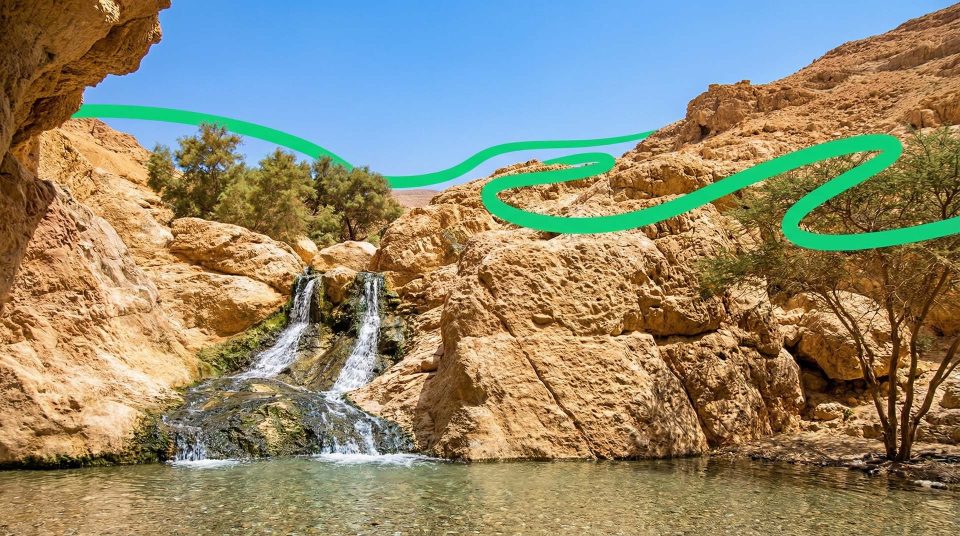
The park's most familiar image is a stream falling into a deep pool between pale walls. The reference description gives the waterfall's height as about 15 metres. Look at it together with its reflections and the surrounding rock. The enclosed shape of the canyon is central to the scene.
3
Ein Ma'arif
The southern spring is associated with the upper canyon, cascades and pools. A viewpoint above reveals the geometry of the gorge differently from a walk through the lower entrance. A stop on the rim does not give permission to descend towards the water along any line you can see.
Why the water outlasts the rain
Springs emerge from the rock layers, maintaining water in the canyon through the dry season. This distinguishes Ein Avdat from nearby dry channels, whose runoff becomes especially apparent after floods. Permanent water does not mean that the waterfall and every backwater look identical throughout the year. Their appearance depends on the supply and local conditions. The brackish water supports plants able to tolerate it, while drier ground nearby has different vegetation. Compare the water's edge with a damp rock face and then the slope above. Over a short distance, the conditions for life change markedly. These differences are central to the oasis and are easily overlooked when attention is fixed on finding one defining photograph.
Euphrates poplars and damp canyon walls
The grove of Euphrates poplars is one of Ein Avdat's characteristic plant communities. The species can grow beside water with elevated salinity. These trees are deciduous: seasonal changes in their leaves bring colours absent from the almost uniformly pale rock. Tamarisks, reeds and other waterside plants also grow along the springs. Maidenhair ferns and lichens occur on moist walls, while algae grow in the water. You do not need to identify every species to make sense of the scene. Notice how a tree follows a strip of available moisture, while a small plant on the cliff depends on a persistently damp surface. Stay on the path rather than approaching roots or picking leaves for comparison. Even a brief step off the route adds pressure to this narrow waterside habitat.
Ibex and birds above the cliffs
Nubian ibex live in the canyon, and its rock faces are important for griffon and Egyptian vultures. Watching them reveals the vertical structure of the place. Some animals use rocky slopes; others make use of air currents and cliff niches. Sightings are not guaranteed on any particular path or at any particular time. If ibex appear nearby, give them room to pass rather than approaching for a close-up. Feeding changes the behaviour of wild animals and draws them towards people when they need to remain independent. For birds, binoculars are more useful than trying to get close to a nesting area. A lack of obvious large animals does not mean the canyon is empty. Its smaller inhabitants, in the water and among the rocks, usually require closer observation.
Lower and upper entrances: different kinds of visit
- Approaching from the lower entrance
- Walking inside the canyon
- The lower access is reached from the Midreshet Ben-Gurion side. It lets you study the channel and water from within the gorge. For an out-and-back walk, choose the turning point from the permitted route map. Do not continue into a section intended for through movement.
- Walking from bottom to top
- A through-route with a climb
- Continuing to the upper exit involves steep sections fitted with climbing aids and requires confidence on an ascent. Arrange your return to the car before starting. This is not a circular route, and you should not assume you can descend the same way afterwards.
- The upper viewpoint
- A view from the plateau rim
- Upper access is linked to Highway 40. It offers a view across the canyon as a separate stop, returning to the same entrance. It does not replace a walk beside the water or establish permission to descend from above.
Decide on the climb before setting out
At Ein Avdat, the fairly level beginning of a walk can give the wrong impression of what follows. Walking beside the channel and climbing out onto the plateau are different undertakings. The ascent may require sure movement on fitted rock steps and comfort with heights. A group with children, limited mobility or anyone uneasy about exposure should select a specific option before entering the canyon. Leaving the decision until later creates difficulties for both walkers and transport arrangements. If some of the group want to remain below, agree in advance on a permitted turning point and a meeting plan. Confirm the direction of travel and available sections with the park administration before setting off. A map kept from an earlier visit does not replace the applicable route arrangements.
Enjoy the waterfall from the bank
Hermits’ caves in the Negev
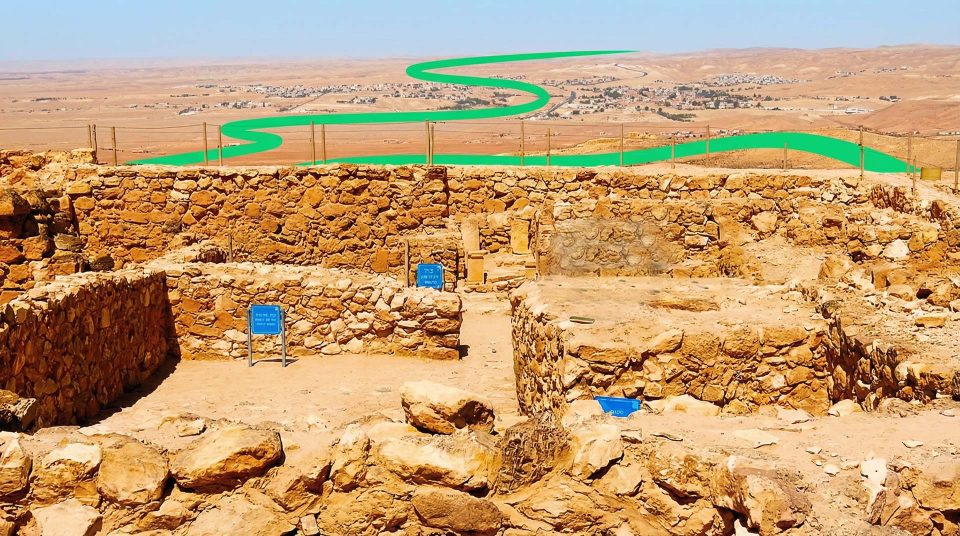
Monks lived in the canyon during the Byzantine period. They adapted caves for daily use, carving shelves, niches, benches, steps and water installations; crosses and prayers marked the walls. Avoid automatically importing the story of the Judean Desert monasteries into this setting. Ein Avdat is in the Negev, with its own landscape and history. The rock dwellings suggest the practical problems a hermit faced alongside the search for solitude. Water had to be found, safe access arranged and living space prepared. A cave visible in a cliff is not necessarily open to visitors. Study any visible traces from the permitted path rather than climbing towards footholds or trying to recreate an ancient approach for yourself.
Nearby places with different stories
1
The ancient town of Avdat
This archaeological complex concerns Nabataean roads and later urban life. Its buildings and ruins contrast with the canyon, springs and plants at Ein Avdat. Similar names do not mean a shared entrance or the same type of walk.
2
The tombs of David and Paula Ben-Gurion
This site on the valley edge near Midreshet Ben-Gurion gives a broad view of the Zin landscape. It is a memorial destination and viewpoint, rather than the starting point of every waterfall route. Compare its panorama with the enclosed space inside the canyon.
3
Ein Akev
Another spring in the Zin Valley system, Ein Akev requires a route plan of its own. Photographs and accounts of its water cannot be used to infer the rules at Ein Avdat. Check names carefully when choosing a nature outing: springs in the same area are not interchangeable.
Light on the walls and seasonal conditions
Pale rock reflects sunlight, and the heat can be strong even inside the narrow canyon. Cool weather makes close observation and climbing more comfortable, although winter calls for protection against wind and an assessment of rain conditions. Flash floods in the drainage system can change the safety of the route. The absence of rain at the entrance is not enough to establish that conditions are safe. In autumn, poplar leaves may add a distinct patch of colour; at other times, reflections of the cliffs draw more attention. Photographers can compare a scene from below and above if their chosen route allows it. You do not need to approach the plateau edge for a complete view. A safe vantage point preserves the perspective and gives you time to study the canyon's shape.
Matching your walk to your transport
- 1
Choose the experience that matters most
Water below, a through-climb and a panorama above are three different aims. Choose the one that suits your group's abilities. The others do not have to become compulsory extensions.
- 2
Match the entrance and exit
For a through-walk, arrange the return from the upper exit in advance. For an out-and-back option, confirm where turning back is permitted. Study the route before reaching narrow or steep sections.
- 3
Pack for a dry-land walk
Bring secure footwear, drinking water and sun protection. Swimwear is not the purpose of preparation: entering the pools is prohibited. Do not rely on the natural water as a drinking supply.
- 4
Confirm access before travelling
Ask the administration which sections are open, the direction of travel and the last admission time for your specific route. Check the forecast and flash-flood warnings separately. Old prices or timetables should not be used for planning.
Questions about visiting Ein Avdat
- Are Ein Avdat and Avdat the same national park? They are separate places. Ein Avdat is a canyon with springs and a waterfall. Avdat is a nearby ancient town with archaeological remains. Use the exact name and the appropriate entrance when navigating.
- Can I swim beneath the waterfall? No. Entering Ein Avdat's pools is prohibited. This protected aquatic habitat is viewed from the permitted route. Clear water or an apparently inviting bank in a photograph does not alter the rule.
- Can I descend from the top along the same path? Do not count on being able to walk freely from top to bottom. The upper viewpoint and the through-ascent from below operate differently. Confirm the permitted direction and available sections before beginning your walk.
- Do I have to climb onto the plateau? No. Different options include a walk from the lower entrance with a return from a permitted turning point, or a separate visit to the upper viewpoint. The choice depends on access arrangements and the group's abilities.
- Am I guaranteed to see ibex? No. Ibex live in the area but do not appear on a schedule. Keep your distance if you encounter them and never feed them. Binoculars are useful for watching birds on the cliffs.
- Are the poplars evergreen? No. Euphrates poplars change their leaves seasonally. Their grove depends on spring water and differs noticeably from the vegetation of the dry slopes. This contrast is an important part of the canyon landscape.
- What should families with children consider most carefully? Choose a route without heights that would be uncomfortable for your group, and settle the return arrangements in advance. The through-climb is different from a walk beside the channel. Children need close supervision by water and on narrow sections.