At a glance
What awaits you
Visit duration
Not yet provided
Difficulty
Not yet provided
Route length
Not yet provided
Who is it for
Popular visiting hours
Verified busyness data is not available yet
Best time to visit
JanFebMarAprMayJunJulAugSepOctNovDec
BestGoodHot
5-day forecast
Forecast loads when this section is viewed
About this place
Nahal Mearot Nature Reserve
Several caves open close together in the limestone face of Mount Carmel, each preserving a different part of human history. Tabun holds a long sequence of Stone Age layers. Gamal helps explain the working of flint. In front of El Wad, a terrace provides evidence for the study of Natufian communities. At Nahal Me’arot, small traces deserve close attention: the edge of a flake, the boundary between deposits, a level space beside an entrance. Researchers use details like these to reconstruct a distant human past.
At the foot of Carmel, facing the coastal plain
Nahal Me’arot Nature Reserve lies on the western slope of Mount Carmel, south of Haifa, approached from the old coastal highway, Road 4. A limestone cliff rises above a valley that opens towards the sea. Its caves are internationally known for their evidence of prehistoric people. Nahal Me’arot means “Caves Stream”; archaeological publications also use the valley’s Arabic name, Wadi el-Mughara. These names refer to the same archaeological landscape. Look at the rock face and at the ground in front of the entrances, because ancient activities left traces in different parts of the complex. The green slopes and view across the plain help explain the setting. They should not be projected unchanged into every period of the Stone Age. The evidence spans changing environments as well as changing human populations, so the present view is a starting point for understanding the site rather than a reconstruction of its entire past.
Four caves with distinct archaeological roles
1
Tabun, also called Tanur
Both names mean “oven”, referring to the chimney-like form of the cavity. Tabun’s importance lies in a long sequence of deposits containing tools, bones and other traces of human activity. It is a good place to begin understanding how archaeologists distinguish periods through layers.
2
Gamal, also called el-Jamal
The “Camel” cave is known for a display explaining Stone Age life. Reconstructions and replica tools help make stone-working and the use of animal materials understandable. Treat them as interpretations designed to explain the evidence, rather than a preserved prehistoric interior.
3
El Wad, also called HaNahal
This site consists of a cave and the terrace immediately outside it. Natufian finds from the entrance and exterior are particularly important. Looking only into the dark interior means overlooking one of the key parts of the archaeological site.
4
Skhul, also called HaGedi
The names refer to a young goat. Remains of early Homo sapiens found here contribute to the study of the early history of anatomically modern humans. The cave’s scientific importance does not establish that its interior can be included in an independent visitor route.
The timescales held within the rock
- About 500,000–40,000 years ago
Tabun was used repeatedly during this broad interval of the Lower and Middle Palaeolithic. Occupation was intermittent. Half a million years of evidence does not mean that a single community lived here continuously throughout that time.
- Towards the end of the Stone Age
El Wad provides evidence for Natufian culture: hunter-gatherers whose settlements and burial practices are important to the study of the periods preceding agricultural societies in the Levant. This is a different stage from Tabun’s earliest layers.
- 1928–1929
Charles Lambert first carried out trial work at El Wad, followed by Dorothy Garrod’s investigations of the caves. Finds demonstrated the scientific value of the rock formation when quarrying for the construction of Haifa’s port threatened the site.
- 2012
Four caves were inscribed on the UNESCO World Heritage List as sites of human evolution on Mount Carmel. Their significance comes from the combined evidence of stratigraphy, human remains, tools and traces of everyday activities.
Tabun: reading the past through layers
Tabun Cave helps explain how researchers build a history without chronicles or written inscriptions. Sand, silt and clay form successive deposits containing flint artefacts and bones. The position of a find within a section matters as much as its shape. Researchers compare layers, analyse plant and animal remains and apply dating methods. An attractive object loses much of its scientific meaning when its original location is unknown. During a visit, look for boundaries within the deposits and imagine naturally accumulated storeys. Those storeys did not form at a uniform rate. A thick band does not necessarily represent a longer span of time, and measuring centimetres cannot produce a calendar date on its own. What looks like a simple wall of earth preserves relationships between objects, sediments and activities. Keeping those relationships intact is essential to the way the evidence can be studied.
What a plain flint flake can reveal
Stone tools are central to the study of the Carmel caves. Handaxes, scrapers and points differ in shape, in the way a blank was struck from a core and in the working of its edge. Tabun contains material from different technological traditions, allowing comparisons between skills practised in widely separated periods. In the displays, connect the stone to a task such as cutting, scraping or preparing a material. An elegant symmetrical point and an unobtrusive flake can be equally useful for understanding a maker’s work. A tool industry, however, should not be used on its own to identify a particular human species. Archaeological classifications of technology and biological classifications of people answer different questions. That qualification matters especially at a site where Neanderthals and Homo sapiens are discussed close together. The form of a tool is one strand of evidence, to be considered alongside its dating and archaeological context.
Neighbouring caves do not prove a face-to-face meeting
El Wad Terrace and life outside the cave
At El Wad, the eye naturally follows the darker space into the rock. Its archaeology also calls attention to the bright, level ground outside. The terrace forms a significant part of the site in its own right. Researchers have investigated Natufian deposits, evidence for the organisation of space and burials here. Their questions concern everyday life: how long people stayed in one place, how they used nearby resources and how living space related to places where the dead were remembered. Natufian communities are generally described as hunter-gatherers. Presenting them as a fully developed agricultural society would oversimplify the evidence. El Wad’s value lies partly in the opportunity to examine changing ways of life before the familiar farming village with fields and domestic livestock emerged. The exterior terrace is therefore essential to understanding the cave complex, even though it lacks the enclosed drama of the interior.
The cave began long before its human inhabitants
Carmel’s limestone formed in a marine environment. Fossils within the rock relate to ancient reef communities, while cavities developed later as water dissolved the limestone. This introduces two very different timescales: the geological formation of the cliff and the much later history of people using it. Prehistoric inhabitants occupied natural shelters and altered them through their activities. They did not cut these caves out in the way the burial chambers at Beit She’arim were excavated into the rock. Rough surfaces, projecting ledges and openings help make that natural foundation visible. Leave any fossil you notice in place. Within the rock, it retains its relationship to the surrounding layer and remains available for someone else to observe. The geological setting contributes to the archaeological story by explaining the shelter people found here, while retaining its own much longer history.
What to compare between the caves
- Tabun
- Layers and a long occupation history
- Concentrate on the sequence of deposits and changes in stone technology. Try to grasp the depth of time represented, rather than searching for a single principal room in which every episode supposedly took place.
- Gamal
- An introduction to work and daily life
- Reconstruction translates archaeological evidence into understandable actions. Compare the scene with the type of tool represented, while keeping a distinction between a museum explanation and an original find.
- El Wad
- Life inside and outside
- The entrance zone and outside terrace are essential to understanding the Natufian phase. A visit that gives all its attention to the cave’s interior leaves out a major part of the evidence.
- Skhul
- Early Homo sapiens on Carmel
- Human remains give this part of the complex particular importance. Its discoveries are worth reading about even when your own permitted route does not include entering the cave.
Excavations that changed the cliff’s future
At the beginning of research here, a practical question was whether the rock should be quarried for building material. Lambert’s trial excavation at El Wad revealed prehistoric finds, including a carved bone object showing an animal. Their importance helped secure the site’s preservation. Garrod’s subsequent work developed isolated discoveries into a more coherent account of the region’s prehistory. Local workers also played important roles in the field. Tabun’s research history records Yusra’s recognition of human remains. A visit offers space to consider the work of discovery itself: a small fragment noticed by a careful observer could carry more significance than the large quantities of stone proposed for extraction. That history adds another subject to the walk. It shows how the value of a landscape can be recognised in time to protect evidence that quarrying would have destroyed.
Planning a visit around the evidence
- 1
Take in the whole cliff face
Begin by locating the entrances on the site map. Parallel Arabic and Hebrew names occur throughout the complex. Remembering them in pairs, together with each cave’s main archaeological theme, is easier than treating them as an unrelated list.
- 2
Distinguish finds from reconstructions
A mannequin or replica tool explains a possible way of life. An original layer preserves material traces. With children, compare what can be observed directly with what has been recreated to make an explanation clear.
- 3
Give the terrace its own stop
At El Wad, the ground outside deserves focused attention. It provides a useful setting for discussing why hunter-gatherers returned to the same place and how researchers investigate evidence of settlement.
- 4
Plan any nature walk separately
Paths on Carmel’s slopes offer a different kind of outing. Choose them using the site plan and the abilities of your group. A visible cavity in the cliff should never be treated as an invitation to make an independent climb.
Practical points for families and nature visitors
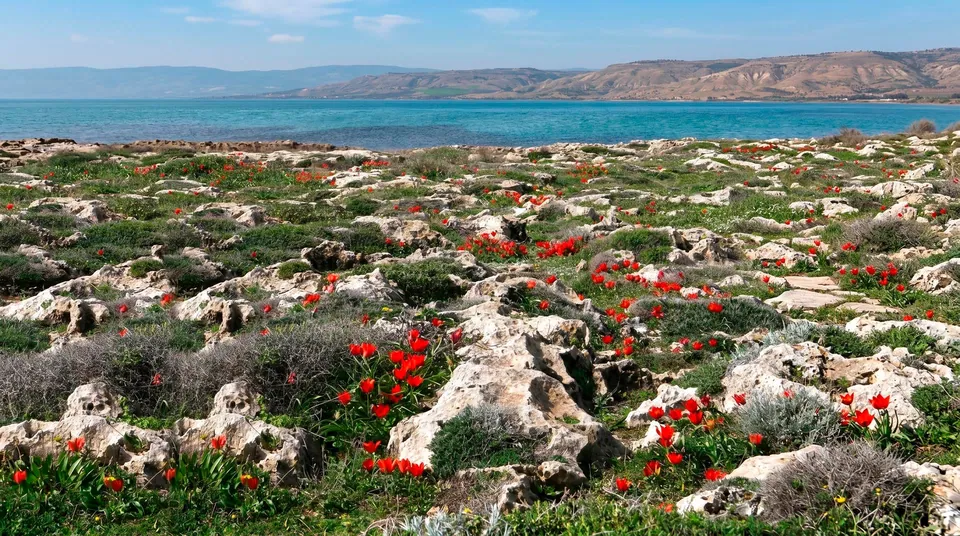
Nahal Me’arot rewards observation, so short, specific tasks work well: distinguish a flake from a handaxe, locate the terrace or compare a bright entrance with a deeper cavity. Introduce children to the people and environments represented here, without promising a search for dinosaurs or treasure. Sloping approaches, steps and exposed areas call for secure footwear, drinking water and a hat. Rock surfaces can become slippery in wet weather. If step-free access matters, check the individual sections you need; an adapted entrance does not describe conditions across the entire hillside. Winter greenery and spring flowers complement the archaeological story. In summer, cooler air within a cave does not remove the heat on the approaches outside. Avoid making a film screening or another display the sole purpose of the trip. Ask the administration about their operation and admission arrangements, while keeping the evidence in the caves and on the terrace central to the visit.
Questions about the Nahal Me’arot caves
- Are Nahal Me’arot and Wadi el-Mughara different places? They are names for the same cave landscape on the western slope of Carmel. Individual caves also have parallel names: Tabun and Tanur, for example, or El Wad and HaNahal. Publications may use either form.
- How many caves are included in the UNESCO site? Four: Tabun, Gamal, El Wad and Skhul. They were inscribed on the World Heritage List in 2012. The archaeological designation includes more than the spaces that a visitor may enter on a particular trip.
- Did the same people live here for half a million years? No. The evidence covers a broad interval of intermittent occupation and traces from different periods. Environments, technologies and human populations changed. Each archaeological layer needs to be investigated within its own context.
- What do the Neanderthal and Homo sapiens finds demonstrate? They make it possible to study the history of different human populations in the Levant. Neighbouring caves alone cannot establish that their inhabitants met at the same moment in time or shared their daily activities.
- Why is the ground in front of El Wad important? The terrace forms part of the archaeological site and contains Natufian evidence. It helps researchers investigate settlement, the organisation of space and the burial practices of hunter-gatherers. It deserves attention alongside the cave itself.
- Should I expect a cave visit focused on stalactites? The main subjects here are prehistoric people, archaeological layers and finds. Karst processes explain how the cavities formed, but an expectation of elaborately decorated stalactite chambers would give a misleading idea of the visit.
- May I climb to any cavity I can see? Follow the authorised route. A scientifically important cave is not necessarily equipped for public entry. Independent climbing on the cliff is dangerous and may damage the archaeological site. Plan any additional nature walk separately.
Sources
History
Tabun was used repeatedly during this broad interval of the Lower and Middle Palaeolithic. Occupation was intermittent. Half a million years of evidence does not mean that a single community lived here continuously throughout that time.
El Wad provides evidence for Natufian culture: hunter-gatherers whose settlements and burial practices are important to the study of the periods preceding agricultural societies in the Levant. This is a different stage from Tabun’s earliest layers.
Charles Lambert first carried out trial work at El Wad, followed by Dorothy Garrod’s investigations of the caves. Finds demonstrated the scientific value of the rock formation when quarrying for the construction of Haifa’s port threatened the site.
Four caves were inscribed on the UNESCO World Heritage List as sites of human evolution on Mount Carmel. Their significance comes from the combined evidence of stratigraphy, human remains, tools and traces of everyday activities.