At a glance
What awaits you
Visit duration
90min
Official 2 km loop takes 1–2 hours; 90 minutes is the range midpoint.
Source and itineraryDifficulty
Easy
Official 2 km loop takes 1–2 hours; 90 minutes is the range midpoint. An accessible paved path leads from parking to the synagogue entrance.
Route length
Not yet provided
Who is it for
Popular visiting hours
Verified busyness data is not available yet
Best time to visit
JanFebMarAprMayJunJulAugSepOctNovDec
BestGoodHot
5-day forecast
Forecast loads when this section is viewed
About this place
Baram National Park
At Baram, three carved doorways catch the eye first. The ancient synagogue’s façade still conveys the building’s scale, although the roof behind it disappeared long ago. Beside the ancient columns, another history survives in the Maronite church and the memories of Biram’s villagers. This Upper Galilee visit rewards anyone who enjoys tracing the past through walls, inscriptions and the way buildings sit beside one another.
A stone façade in the Upper Galilee hills
Baram National Park lies in the mountainous Upper Galilee, off Road 899 between Sasa and Baram. The archaeological site contains the remains of an ancient Jewish settlement and the later village of Kafr Bir’im, also known as Biram. Nearby Kibbutz Baram is a separate destination; use the park’s actual entrance when planning your drive. The principal monument comes into view almost at once: the tall synagogue façade with its three doorways. It preserves an architectural composition that would be difficult to reconstruct from foundations alone. Behind it are the remains of the hall, while a Maronite church stands nearby. Give each its own attention. The ancient building and the church, which remains a place of worship, belong to different communities and different chapters in the life of this hill.
Baram at a glance
3 Doorways in the southern façade
South Direction of the main façade
2 Historic synagogues
Reading the synagogue façade
Begin far enough back to take in the whole façade. The central doorway stands out for its size and elaborate decoration; the side doorways give the composition its symmetry. Window openings and carved details survive above them. Doorframes, projecting cornices and columns in front of the entrance give depth to what might otherwise appear to be a flat wall. The south-facing front points towards Jerusalem, an orientation characteristic of Galilean synagogues. Notice, too, how differently the façade and the rest of the building have survived. The imposing entrance wall outlasted the roof and much of the interior structure, so the ancient synagogue at Baram looks considerably more complete from outside than it does within. Its present appearance also reflects conservation and restoration. These works help visitors understand the original design; they should not be taken to mean that the entire building has survived unchanged.
Details to find at the Great Synagogue
1
The central doorway
Look at its frame separately from those of the side doors. Its size and carving established the importance of the main entrance before anyone entered the hall. Then step back to see how that decoration fits into the symmetry of the whole wall.
2
Columns in front of the façade
These belonged to the portico, the covered space between the open ground and the entrance. A view from the side reveals its depth. A photograph taken straight on can flatten a space that originally had a substantial three-dimensional form.
3
The inscription below the right-hand window
An Aramaic inscription preserves the name Elazar bar Yodan in connection with the building’s construction. Even if you cannot read the language, notice where it sits. An individual’s name was incorporated into a communal building, rather than commemorated on a separate modern monument.
4
The remains of the interior colonnade
Rows of columns divided the hall and supported the structure above. Compare them with the doorways and the lines of the walls. They help restore the building’s volume in your mind: seemingly almost complete from the front, yet open to the sky inside.
Reconstructing the lost hall in your mind
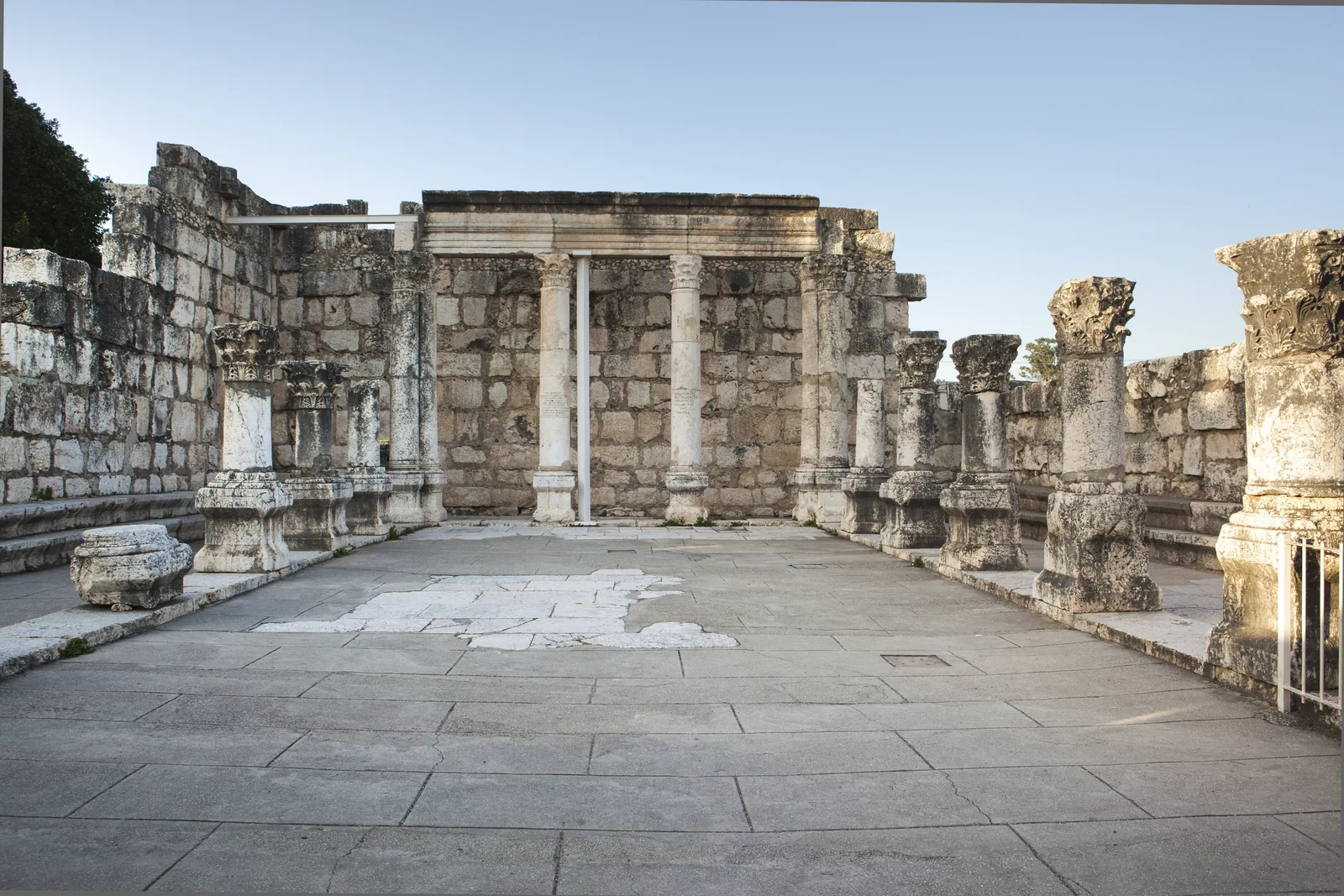
Explore the interior after looking at the façade. The entrance wall establishes the scale, while the surviving ground plan helps explain how people moved through the building. Columns divided the hall into aisles and an ambulatory, a passage around the interior. Their arrangement shows the careful organisation of a communal space. Trace the relationship between the central doorway, the main part of the hall and the side passages. A roof, controlled light and rows of supports would have created a very different atmosphere from today’s open ruins. The surviving stonework also makes the community’s investment easier to appreciate. Regular proportions, dressed architectural elements and carved decoration required skilled work. An impressive façade cannot, however, reconstruct every aspect of village society or establish that every household was wealthy. It offers firmer evidence of a substantial shared building project than of the means of each individual resident.
Dating the synagogue and understanding its traditions
Baram belongs to the group of ancient Galilean synagogues built during the Roman period and late antiquity. The Great Synagogue is commonly dated to the third century CE, although its construction history, reused components and later repairs are more complicated than a single date suggests. For a first visit, it is useful to place it within Jewish life in Galilee during the periods of the Mishnah and Talmud. A later tradition associated the synagogue with Rabbi Shimon bar Yochai. Treat that association as religious memory, rather than archaeological identification of the person who commissioned the building. The façade inscription, the ground plan and travellers’ accounts provide different kinds of evidence. Comparing them is rewarding, provided a material find, a medieval description and a tradition retain their separate meanings. Stories about this place circulated long before the ruins were studied systematically.
The changing synagogue and village
- Roman period and late antiquity
The ancient Jewish settlement developed its architectural complex. The Great Synagogue follows the Galilean type, with a south-facing façade and extensive carved stone decoration.
- The Middle Ages
Travellers recorded two synagogues here. Their descriptions matter because some of the architectural details and parts of the buildings they saw later disappeared.
- 1837
A powerful earthquake damaged the village, its church and standing parts of the ancient synagogue. What survives today reflects both destruction and subsequent restoration.
- 1852
Edward Robinson studied the ruins and compared them with other ancient Galilean synagogues. Travellers’ observations helped establish how these buildings came to be recognised archaeologically.
- 1948
The inhabitants of the Maronite village were forced to leave their homes. Village life was never re-established, while the church retained its importance for the displaced community.
- 1953
The village buildings were destroyed. The church and surrounding house ruins should therefore be understood in the context of a lost settlement, rather than gradual, natural abandonment.
The smaller synagogue and a lintel in the Louvre
Baram had two synagogues, and their states of preservation differ sharply. At the larger building, the façade is almost an architectural drawing in stone. Little of the smaller synagogue remains visible, but part of its story continues in a museum collection: a carved lintel is in the Louvre. Its inscription wishes peace upon this place and the places of Israel. The object illustrates how a monument’s evidence can be divided between its original setting and a distant museum. In the park, you can understand the settlement’s position and the scale of the larger building, while some important objects are preserved far from their findspot. Do not expect a second façade comparable to the main one, or leave marked areas to search for more remains. The smaller synagogue’s significance lies partly in what it tells us about communal life here: ancient Baram had more than the single celebrated building that dominates a visit today.
Biram’s Maronite church and the villagers’ memory
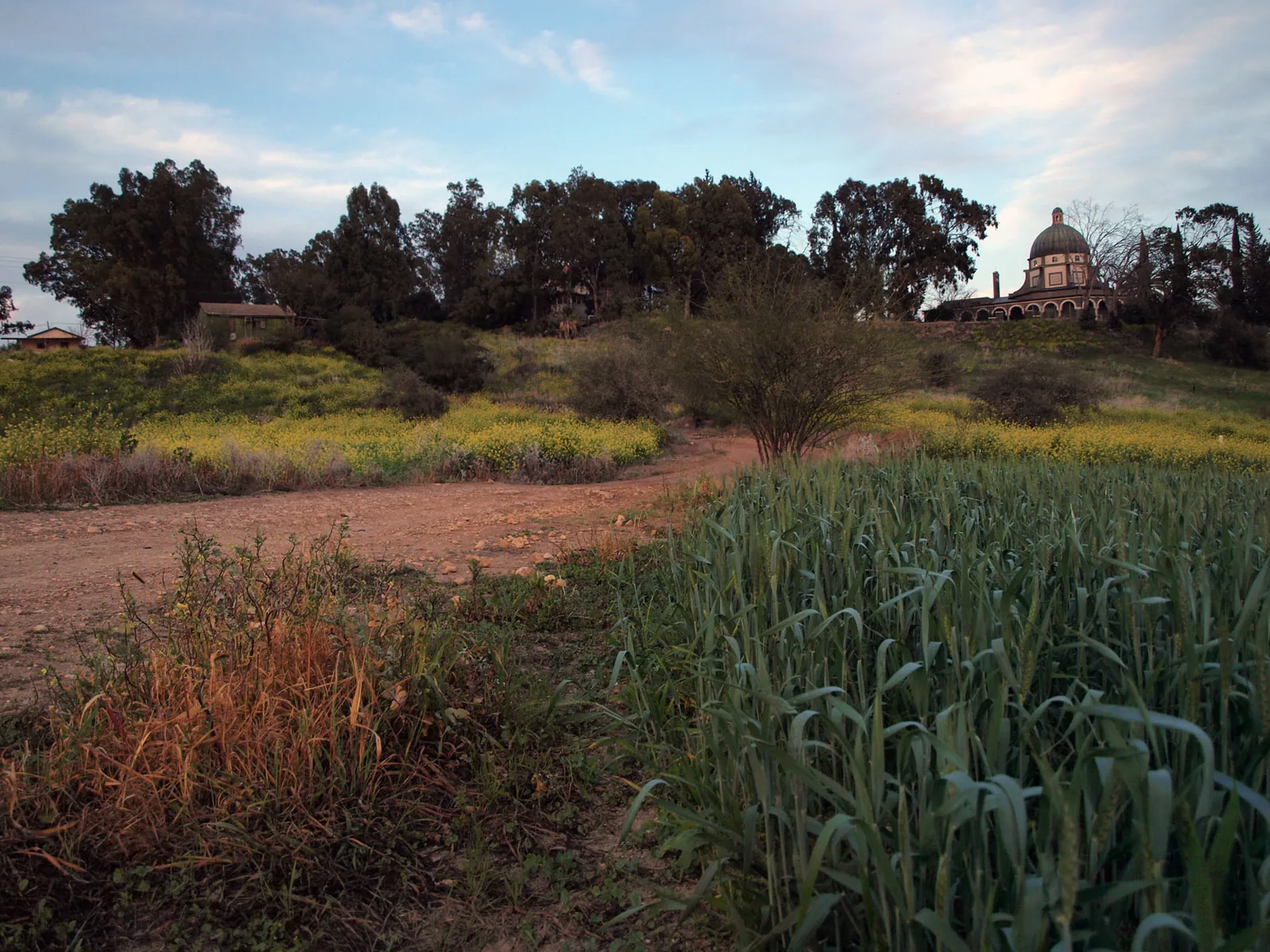
The Maronite church at Biram remains a spiritual centre for the former village’s community. Alongside the ancient façade, it connects the site with people for whom this is still part of their family history. In the nineteenth century and the first half of the twentieth, the village was predominantly Christian. Its residents farmed the surrounding land, growing olives and fruit. Their expulsion in 1948 and the destruction of the village buildings in 1953 interrupted that life. Descendants continue to maintain ties with the place and its church. This history deserves a direct account, rather than treatment as picturesque background for a photograph. Visit the church surroundings respectfully; entry depends on church activities and permission on site. A religious service is an act of worship. Ask permission before photographing anyone taking part in prayer or a family gathering.
Similar names, different places
- Baram National Park
- The main destination for this visit
- The archaeological site includes the Great Synagogue, settlement remains and the church. Its focus is architecture and the histories of different communities.
- Kafr Bir’im, or Biram
- The later village’s history
- The name of the former village whose ruins lie beside the ancient monument. It refers to a historic settlement and to the memories of its inhabitants.
- Kibbutz Baram
- A separate cultural stop
- A distinct modern community. Its Bar-David Museum displays art, Judaica and regional archaeological material; visiting the museum requires separate planning.
- Woodland trails around Baram
- A different kind of walk
- A walk in the surrounding countryside needs its own choice of trail. The nearby woodland does not make a visit to the archaeological park a long forest hike.
A visit with time to look closely
- 1
Start with a distant view of the façade
Find the central axis and side doorways before approaching the carving. The building’s overall design becomes clearer when you first see it as a whole, rather than as a collection of old stones.
- 2
Choose a few details to compare
Compare the doorframes, portico columns and position of the inscription. Children can find the three entrances and explain which seems most important. Looking for details gives them a useful task while keeping them off the masonry.
- 3
Move on to the interior plan
See how the surviving columns relate to the passages. Picture the lines of the lost roof from the permitted route, keeping off supports and staying behind barriers.
- 4
Give the church its own time
Shift your attention from ancient architecture to the history of the community. Quiet observation and respect for activities here acknowledge that the park contains a living place of remembrance.
Mountain weather and light on the stone
A visit to Baram in the Galilee hills feels different from a walk beside the hot shores of the Sea of Galilee. Bring an extra layer in the cooler season, and take care on stone and earth between the monuments after rain. In sunshine, side lighting makes the carving easier to read: small shadows reveal the relief, and a doorway that looks flat in a photograph gains depth. Leave time for views from an angle and for studying the relationship between the façade and the columns in front. If step-free access is essential, check the route to the particular features you want to see. Adapted facilities at an entrance cannot describe every surface among historic buildings. Confirm visiting arrangements and ticket conditions with the Israel Nature and Parks Authority before setting out. Plan any woodland walk or museum visit separately. Even if Baram is the only archaeological stop of the day, allow enough time to compare the buildings and their very different histories.
Questions about Baram’s synagogue and village
- What makes Baram different from a site with only foundations? The tall façade of the Great Synagogue survives particularly well, with three carved entrances. It lets you grasp the proportions of a communal building, then compare them with the open remains of its hall.
- When was the Great Synagogue built? It belongs to the Roman and late-antique group of Galilean synagogues and is often dated to the third century CE. Its construction history includes alterations, so an exact building year should not be treated as established.
- Which way does the façade face? South, towards Jerusalem. This helps explain the building’s orientation. The central doorway is distinguished by its size and decoration, while the side entrances contribute to the façade’s symmetry.
- Is the second synagogue equally well preserved? Very little of the smaller synagogue survives. Its well-known carved lintel is in the Louvre. Visitors should not expect another complete façade alongside the Great Synagogue.
- Is the church part of the ancient synagogue? The Maronite church belongs to the later village of Biram and remains a spiritual centre for its community. It represents another period of the site’s history, with separate arrangements for entry.
- Is Baram suitable for children? Children who enjoy looking for doorways, columns and carved details can find plenty to notice. The ruins are unsuitable for climbing. Check access to the features you want to visit if you are bringing a pushchair.
- Does a park visit include the forest and Bar-David Museum? The archaeological park, woodland trails and museum in the kibbutz are separate destinations. Choose any extra walk to suit your group and check the museum’s visiting arrangements independently.
Sources
History
The ancient Jewish settlement developed its architectural complex. The Great Synagogue follows the Galilean type, with a south-facing façade and extensive carved stone decoration.
Travellers recorded two synagogues here. Their descriptions matter because some of the architectural details and parts of the buildings they saw later disappeared.
A powerful earthquake damaged the village, its church and standing parts of the ancient synagogue. What survives today reflects both destruction and subsequent restoration.
Edward Robinson studied the ruins and compared them with other ancient Galilean synagogues. Travellers’ observations helped establish how these buildings came to be recognised archaeologically.
The inhabitants of the Maronite village were forced to leave their homes. Village life was never re-established, while the church retained its importance for the displaced community.
The village buildings were destroyed. The church and surrounding house ruins should therefore be understood in the context of a lost settlement, rather than gradual, natural abandonment.