


Water Activities
No matching experiences
Try a wider area or different filters.
Good to know
Which water activities in Israel offer a shared family outing?
Kfar Blum’s family river course uses shared craft on a 4-kilometre route. Aqua Kef offers floating obstacles on the Kinneret. The Underwater Observatory in Eilat provides a reef-focused dry visit. Choose according to the actual participants and the requirements of each programme.
How long is the Kfar Blum family river route?
The operator publishes a distance of 4 kilometres. Allow extra time for registration and the operator’s transfer to the launch at Beit Hillel or Gan BaTzafon. Keep the schedule flexible rather than treating the river distance as an exact journey time.
Can a family of six count on travelling in one river boat?
Kfar Blum describes boats for up to six people, but the launch staff sets the actual loading according to restrictions and water flow. The maximum boat capacity does not guarantee that every group of six will travel together.
Do you need to swim for kayaking on the Jordan?
Kfar Blum’s FAQ specifies basic swimming knowledge. Its safety rules also require a flotation jacket throughout and prohibit leaving the craft to enter the river. A jacket should not be treated as permission for someone who does not meet the participation requirements.
What does the Aqua Kef floating-park ticket include?
The operator says the ticket covers its family and challenge areas. Floating-park sessions are listed as 45 or 90 minutes. Other attractions at the complex require separate tickets; Aqua Race is listed as an eight-minute activity.
What do you learn in a beginner SUP course?
Lev HaYam’s programme covers getting onto the board, stance and paddling technique. Practical work includes turns, pivot-foot movement and paddling over a distance. Its published format is two one-hour meetings, with a base course price of NIS 415 for one participant.
How does sea kayaking in Tel Aviv differ from a river trip?
Lev HaYam’s sea-kayak course teaches equipment use and several strokes, along with rescue practice and entering and leaving through waves. The Kfar Blum family product is a shared downstream journey. They are different programmes with different learning goals.
Is a basic sailing course a one-off cruise?
Lev HaYam lists five two-hour meetings covering boat handling, sail control and other practical topics. Its base course tariff is NIS 2,400 for one participant or NIS 3,680 for a pair. This is a learning programme rather than a passenger cruise.
Does Topsea offer adult beginner surfing lessons?
Topsea describes an adult beginner course of four meetings that can be used within three months. The centre is on the Tel Aviv coast and lists private lessons and training by level separately, so compare the specific format that fits your available time.
What is a banana ride in Eilat?
It is a ride on an elongated inflatable towed by a motorboat. Participants sit together and balance as the boat turns. Eilat’s tourism portal lists it among the city’s water sports; the actual operator sets the conditions for the people taking part.
Can a beginner simply swim out to the Japanese Gardens?
The Eilat tourism portal describes the Japanese Gardens as a dive site reached by a divers’ boat, with organised guided dives. Discuss the site with a dive centre rather than treating it as a casual beach swim or assuming it is an introductory dive.
Can you see Eilat’s reef without swimming?
The Underwater Observatory tower has a dry viewing room 6 metres below sea level, reached by stairs. The park also describes Coral 2000, a glass-bottom boat tour of about 35 minutes. The tower is not accessible with children’s strollers, so plan that part separately.
Related categories
1. Choose what you want to do on the water
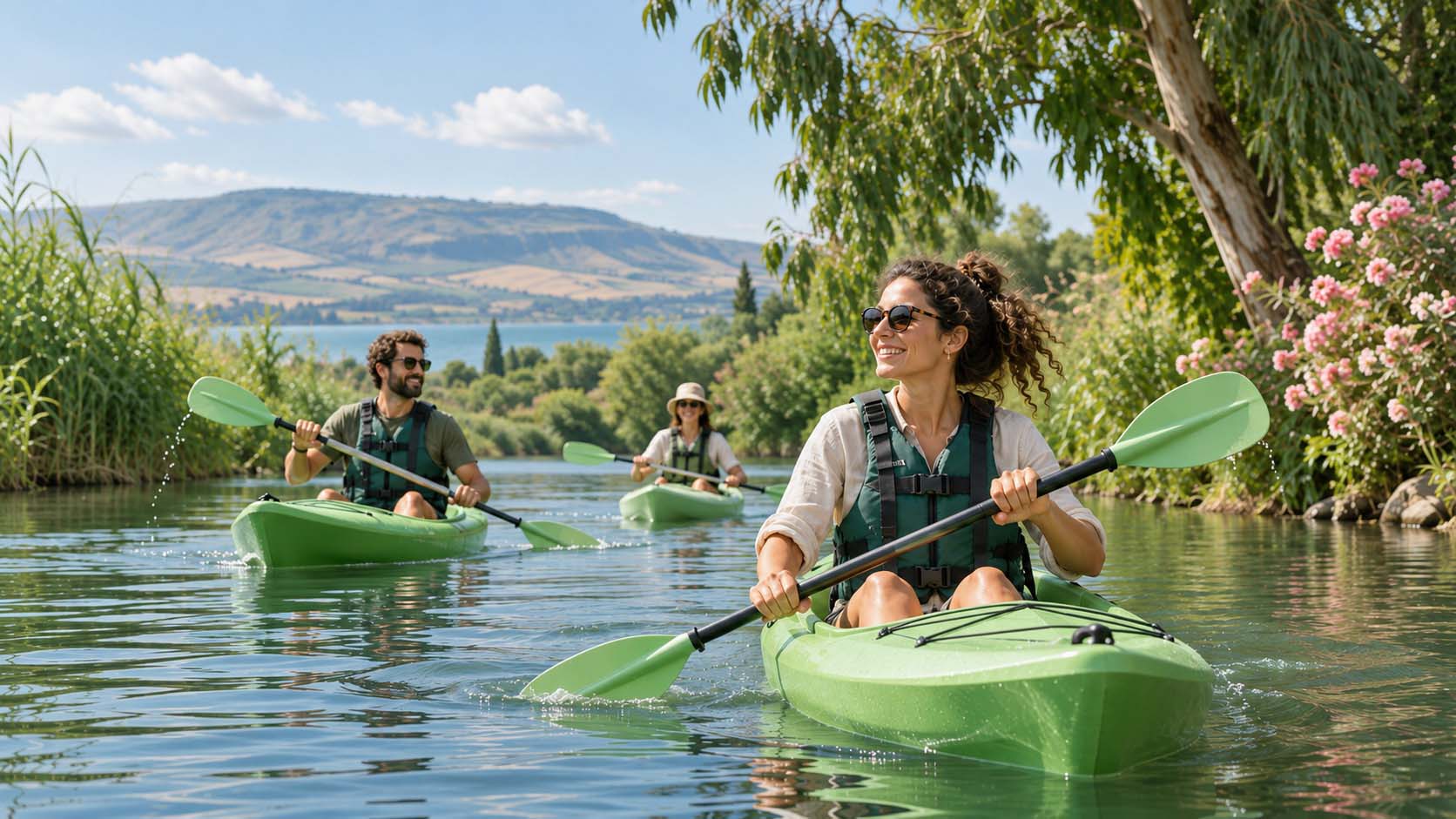
A paddle catches the current on the Upper Jordan. On the Kinneret, someone is trying to cross a floating bridge before their friends tumble off it. In Tel Aviv, a beginner practises turning a SUP board; in Eilat, a family watches reef fish through a window below sea level. Water activities in Israel involve very different kinds of participation. Start with the movement you want to try, then choose the setting.
For a shared outing, compare the family river route at Kfar Blum with the floating obstacles at Aqua Kef. For a skill you can return to, look at a SUP, sea-kayaking or sailing course at Lev HaYam, or adult surfing lessons at Topsea. Eilat adds towable rides and underwater observation. A course spreads learning across several meetings, while a timed attraction fits into a shorter visit.
A river boat carries a group downstream. A sea kayak or SUP lesson puts more attention on your own strokes and control.
Aqua Kef on the Sea of Galilee has floating bridges, climbing features and slides, with timed sessions for the inflatable park.
The Underwater Observatory in Eilat lets you look into the Red Sea from a dry room reached by stairs.
2. The Upper Jordan and Kfar Blum river tradition
Kfar Blum places the beginning of its kayaking operation on the Hatzbani and Jordan in 1986. Organised river trips have been part of this Upper Galilee operator’s work for decades. Its family route gives a concrete starting point for comparing kayaking on the Jordan, with a published distance of 4 kilometres.
The route uses river craft that can take up to six participants. The launch team decides the actual number in each boat according to the restrictions and water flow. A six-seat description therefore gives the maximum capacity rather than a promise that any six people will be placed together. For a family, the shared boat makes the outing a joint activity, with adults and children responding to the same bends and current.
Kfar Blum describes a waterfall feature towards the end of the family course. Expect a river outing with splashes and a change of pace there. The family label should not be read as a guarantee of flat water throughout. River level and flow also affect how the route feels, so the distance is a more useful fixed comparison than a tightly scheduled finish time.
The operator explains that visitors register at its Kfar Blum site and take its transport to the launch at Beit Hillel or Gan BaTzafon. Registration and the river start are separate places. Build the transfer into the outing rather than driving straight to a riverbank because it appears to be the beginning of the route.
3. What taking part in a river trip involves
A family river boat is a shared craft: paddling and steering happen alongside the movement of the water. Before launching with Kfar Blum, participants must watch the instruction video and receive the guide’s boating and safety directions. This is where the crew explains how to use the equipment and respond on the route. Give the briefing your full attention before getting into the boat.
The operator requires a flotation jacket throughout the trip and prohibits getting out of the kayak or raft into the river along the way. A river trip therefore has a different rhythm from a swimming stop. Stay with the boat and use the assistance procedure explained by the staff if you need help. The safety page also warns against grabbing branches along the natural riverbanks.
For family water activities, swimming ability deserves a direct answer. Kfar Blum’s FAQ specifies basic swimming knowledge, and its safety guidance says minimum age varies with the speed of the current. Avoid treating a remembered age from an earlier summer as permission for another trip. The staff needs the actual children’s ages and abilities when deciding whether this route is appropriate.
- At the Kfar Blum briefing, learn the boat-handling instructions and how to request assistance.
- Wear the required flotation jacket for the whole route and remain in the craft.
- Use footwear suitable for the outing and bring drinking water, as the operator instructs.
- Keep valuable electronics and other precious belongings off the boat; the operator warns that personal equipment can be lost or get wet.
4. Floating obstacles on the Sea of Galilee
Aqua Kef is at Ganim Beach in Tiberias, on the Kinneret, also known as the Sea of Galilee. Its floating water park turns the lake visit into an obstacle session. The family area includes trampolines, jumping platforms, an obstacle bridge, a climbing wall and ladders. A separate challenge area has more demanding equipment and slides.
Here, the activity is crossing, climbing and trying again after a splash. That makes it a useful alternative for friends who want to move around a course together rather than spend the outing sitting in one boat. The family and challenge areas belong to the floating-park ticket. Other attractions at the same complex have their own tickets, so the site name alone does not define what you have purchased.
Aqua Kef lists floating-park sessions of 45 or 90 minutes. Aqua Race is a separate, eight-minute activity. Compare each ticket using its own activity time. Among water activities on the Sea of Galilee, the floating park offers a contained session that can fit alongside another lake stop.
The operator describes its bathing season as roughly two weeks before Passover to two weeks after Sukkot. This is a seasonal pattern, not a fixed date for every year. Beach hours and attraction sessions are also separate. Choose an actual floating-park session rather than assuming the obstacles operate whenever the beach is accessible.
5. SUP lessons in Tel Aviv
Stand-up paddleboarding uses a board and a paddle to move across the water while standing. At Lev HaYam in Tel Aviv, a beginner practises getting onto the board and finding the right stance. The SUP syllabus then covers paddle technique, turning and paddling over a distance.
The useful part of a SUP course is learning to change direction deliberately. The Lev HaYam programme includes pivot-foot turns and practice with efficient strokes. Those exercises give a beginner specific things to work on after the first successful stand. If you want an active introduction to the Mediterranean, a lesson gives more structure than collecting a rental board and heading out alone.
Lev HaYam publishes a beginner SUP course of two one-hour meetings, with a base course price of NIS 415 for one participant. Treat that as the club’s named course example, subject to its terms and any tariff changes. It is a complete two-meeting programme rather than an hourly rental price or a national average for stand-up paddleboarding.
6. Sea kayaking teaches a different set of movements
Sea kayaking in Tel Aviv gives you a seated paddling position and a syllabus built around controlling the boat in open water. Lev HaYam begins with the kayak and its equipment, including the paddle, flotation jacket and spray skirt. The spray skirt is the cover around the cockpit. The course includes getting into the kayak and practising how to get out on shore.
On the water, the published exercises cover forward and reverse paddling, turns and sideways movement. A sideways stroke gives the paddler another way to position the craft. The programme also includes rescue practice and manoeuvres for entering and leaving through waves.
These are instructor-led learning topics. A description of a rescue exercise is not a set of instructions for trying it alone. Choose this format when you want to understand the craft and practise under supervision. It asks for a different commitment from the shared river route at Kfar Blum, where the family boat and downstream journey are the centre of the experience.
7. Sailing lessons on the Mediterranean
Lev HaYam’s basic sailing course in Tel Aviv is built around operating a sailing boat. It starts with sailing terms and rigging the craft, then covers handling it in different winds. Participants practise turns and sail control, along with leaving the shore and returning. The learning is about the relationship between the sail and the boat’s direction.
The syllabus also includes basic right-of-way rules, man-overboard procedures and emergency topics. Those elements matter when choosing between sailing lessons and a leisure cruise. On a course, you devote time to handling and decisions. On a passenger outing, the crew handles the vessel. Choose the course if learning the work behind the movement is the attraction.
The club lists five two-hour meetings for its basic course. Its published base prices are NIS 2,400 for one participant and NIS 3,680 for a pair. The pair price refers to the two-person course option, not a per-person tariff. These examples belong to Lev HaYam’s stated programme and should not be applied to yacht charters or other sailing schools.
8. Surfing in Tel Aviv and the Topsea story
Topsea locates its surfing activity on the Tel Aviv coast between Gordon and Hilton beaches. The centre traces its tradition to Shamai ‘Topsy’ Kantzipolski in the late 1950s. Its account describes the family connection continuing through his son Oriyan and a third generation involved in the centre.
For adults starting out, Topsea describes a four-meeting beginner course that can be used within a three-month period. That format provides repeated visits to the sea. A Tel Aviv resident can return to practise across several weeks. A visitor needs a stay long enough to accommodate the meetings.
Surfing lessons and SUP lessons use boards for different purposes. SUP training focuses on moving with a paddle and controlling the board through stance and strokes. A surfing programme is centred on riding waves. Choose between them according to the movement you want to learn.
Topsea also lists private lessons and adult training by level. Children’s activities have their own formats, including camps and regular groups. For a first surfing course, use the adult beginner programme as the comparison rather than an advanced training group.
9. Eilat’s towable rides and northern-beach water sports
Water activities in Eilat include a particularly social kind of ride: a banana-shaped inflatable towed by a motorboat. Participants sit together and work with the movement of the inflatable as the boat turns. Eilat’s tourism portal describes balancing as part of the group experience. Expect speed and splashes rather than a lesson in independently handling a craft.
Towable tubes are another format listed by the city’s tourism portal. The difference from a passenger cruise is immediate: you are on an inflatable at water level, responding to acceleration and turns. For a group choosing one short shared activity, name the precise ride. A speedboat trip, a banana ride and time on a tube are separate experiences even when they leave from the same stretch of beach.
Hananya Beach, beside the northern marina, is one of the places the portal identifies for water sports. Its list includes pedal boats and kayaks, along with towable tubes, jet skis, parasailing and water skiing. That range allows a group to consider different levels of participation. It does not establish that every listed activity is suitable for every child or beginner.
Parasailing takes the participant into the air under a canopy towed by a boat. Water skiing keeps the rider on the water and involves a different task. If the family is divided between the two, compare the actual movements and the operator’s conditions. A general water-sports package label is too broad to tell you which ride each person will do.
10. Seeing Eilat’s reef from the water
Snorkelling in Eilat keeps reef observation close to the surface; scuba diving uses different equipment and training. The city’s tourism portal describes both as ways of exploring the Red Sea, with diving schools concentrated along the southern coast. Choose the format around the participant’s experience and the specific session, rather than assuming a reef-viewing activity is automatically a beginner dive.
The Japanese Gardens, opposite the Underwater Observatory, provide a useful example of why the site name matters. The tourism portal describes access by a divers’ boat and organised guided dives. This is a boat-dive destination to discuss with a dive centre. Treating it as a casual swim from the beach would leave out the actual way the visit is organised.
Along the southern coast, the city portal identifies Coral Beach as a setting for snorkelling and diving. It also describes the Caves site, where coral arches give the underwater formations their name. These are places to observe carefully with suitable supervision and control in the water. Keep clear of the coral and follow the site’s permitted route; an underwater arch is no invitation to swim through it.
Reef observation can also be the reason to skip an active water session altogether. If someone wants to see coral and fish but is uncomfortable swimming, choose a dry viewing format at the Underwater Observatory. This keeps the shared interest in marine life while changing how the person takes part. It also avoids using a flotation jacket as a substitute for swimming ability.
11. The underwater tower, an aquarium and a glass-bottom boat
At Eilat’s Underwater Observatory, visitors walk down stairs to a viewing room 6 metres below sea level. Its windows look into the Red Sea, where fish, coral and invertebrates can be observed in their natural surroundings. You remain inside a dry room. For a family with different levels of water confidence, this gives everyone a reef-focused visit without requiring a swim.
The park’s Red Sea Reef exhibit is a different setting: a circular aquarium on land containing live corals and reef fish. The distinction is worth keeping clear. Through the tower windows you look into the sea; at the aquarium you see a constructed display of reef habitats. Both concern marine life, but they are separate parts of the visit.
Coral 2000 adds a third viewpoint. The operator describes a glass-bottom boat tour lasting about 35 minutes, with reef observation during the cruise. This combines being on the water with looking down into it. It is a more specific choice than asking for a boat trip and assuming an underwater view will be included.
The tower is reached by stairs, and the operator states that its underwater observatory is not accessible with children’s strollers. Families using a pushchair should plan that part of the visit separately. For other mobility needs, use the park’s actual access information for the desired area rather than treating all its attractions as having identical access.
A dry room below sea level, with a view into the natural marine environment outside.
A circular onshore exhibit with living corals and fish, representing several reef habitats.
A glass-bottom boat cruise described by the operator as approximately 35 minutes.
12. Compare the programme, the time and the price unit
A useful comparison of water activities in Israel starts with what the participant actually does. The 4-kilometre family river course, a 45-minute obstacle session and five sailing lessons ask for different amounts of effort and planning. Use the named programme and its unit of sale when looking at prices. Published course tariffs are examples to reconfirm with the provider, not a fixed price for the entire category.
| Place and programme | Participation and published format | Price or comparison point |
|---|---|---|
| Kfar Blum, Upper Galilee | Family river course, 4 km; boat loading set by staff | Compare the river ticket and transfer arrangements; do not assume six guaranteed seats |
| Aqua Kef, Ganim Beach, Tiberias | Floating family and challenge areas; 45- or 90-minute sessions | Aqua Race is separate and has its own ticket |
| Lev HaYam, Tel Aviv: beginner SUP | Two one-hour meetings for one participant | Published base course price: NIS 415 |
| Lev HaYam, Tel Aviv: basic sailing | Five two-hour meetings | Published base course price: NIS 2,400 for one or NIS 3,680 for a pair |
| Topsea, Tel Aviv: adult beginner surfing | Four meetings, usable within three months | Compare a course with the separate private-lesson and training formats |
| Underwater Observatory, Eilat | Tower, onshore exhibits or Coral 2000 boat programme | Specify the chosen attraction; a viewing visit and an active water session differ |
For a northern day out, choose between travelling downstream on the Upper Jordan and moving around floating obstacles on the Kinneret. In Tel Aviv, decide how many meetings you want to devote to learning a board or boat skill. In Eilat, compare the northern-beach rides with a southern-coast reef visit.
- Identify the exact product: family river course, floating park, board lesson, sailing course, towable ride or reef-viewing visit.
- Match the participation to each person: shared paddling, individual practice, climbing, riding or watching from a dry room.
- Keep the time unit visible: one attraction session, one lesson or the full sequence of meetings.
- Read the named operator’s swimming, age and equipment conditions for that product; one attraction’s rules do not authorise another.
- For a course, arrange the later meetings as well as the first one. For Aqua Kef, choose the specific attraction session rather than relying on beach opening hours.