


ATV and Buggy Tours
No matching experiences
Try a wider area or different filters.
Good to know
What is the difference between an ATV and a buggy?
A conventional quad-style ATV uses a straddle seat and handlebars. A side-by-side uses separate seats and steering-wheel controls. Buggy is a broad advertising label, so identify the exact model and capacity. RZR Eilat, for example, states that its vehicles have four seats in total.
Do ATV tours in Israel mean independent vehicle rental?
The format depends on the programme. RZR Eilat describes self-driving behind a guide, so the participant controls the vehicle within an organised outing. That description does not offer unrestricted independent route choice. Check whether your proposal is guided self-drive or another arrangement.
What does the one-hour RZR Eilat programme include?
Its published route names the Camel Ranch, lower Nahal Shlomo, Nahal Rehavam and upper Nahal Shlomo. The description mentions climbs and descents and a break with cold water, tea and coffee. Those are details of this programme rather than inclusions for every tour.
How does the ninety-minute programme differ?
The RZR Eilat ninety-minute itinerary adds the old road to Eilat and Mount Yoash to the Shlomo and Rehavam places. It also describes a refreshment pause. Compare those named additions and the extra time outdoors when deciding between the two programmes.
What is listed in the three-hour Eilat outing?
RZR Eilat describes a private programme including Nahal Shahmon, the Nahal Netafim overnight campsite, upper Nahal Roded, Shkhoret Canyon, Nahal Amram and the Amram Pillars. The campsite is a route landmark; an overnight stay is not stated as part of the three-hour trip.
How old must a RZR Eilat driver be?
The operator publishes a normal threshold of twenty-three with a valid driving licence. Its FAQ also mentions an exception for younger drivers when parents join or give telephone permission. Resolve that individual case with the operator; this is not a general legal rule for all buggy tours in Israel.
Can a family of four use one vehicle?
RZR Eilat states that its vehicles have four seats, including the driver. Its FAQ gives a minimum participation age of three, and the main page mentions child safety seats. The organiser still needs to confirm the actual seating arrangement and eligibility for each person in your family.
Does EZRaider at Camel Ranch require a driving licence?
The ranch states that a driving licence is unnecessary for its EZRaider activity and gives sixteen as the minimum age for independent participation. Riders receive a short introduction. These rules apply to that programme and should not be transferred to RZR or quad driving.
Can a child ride as an EZRaider passenger?
Camel Ranch describes a separately charged child-passenger option up to forty kilograms and up to 1.10 metres tall, with a combined limit of 130 kilograms per vehicle. All the conditions apply together. Confirm the arrangement for the actual adult and child before booking.
What should EZRaider riders wear?
Camel Ranch specifies comfortable clothing and closed shoes, preferably walking or sports shoes. Hair must be tied back, and the supplied helmet and protective equipment must be worn. The ranch also says the activity is unsuitable during pregnancy or for people with back problems.
Is there a standard national price for buggy tours?
Compare a written quote for your exact party and programme. The RZR Eilat pages used for this guide invite quotation requests rather than providing a numeric tariff. Establish the charging unit, duration and inclusions, then read any deposit and damage obligations separately.
Does an Eilat buggy outing automatically include Timna?
Choose by the published itinerary. The RZR Eilat programmes described here name places around Shlomo, Yoash, Roded, Shkhoret and Amram according to duration. Those descriptions do not establish a Timna visit or a swimming activity. Plan other attractions separately unless explicitly included.
Related categories
1. Choose the drive you want to remember
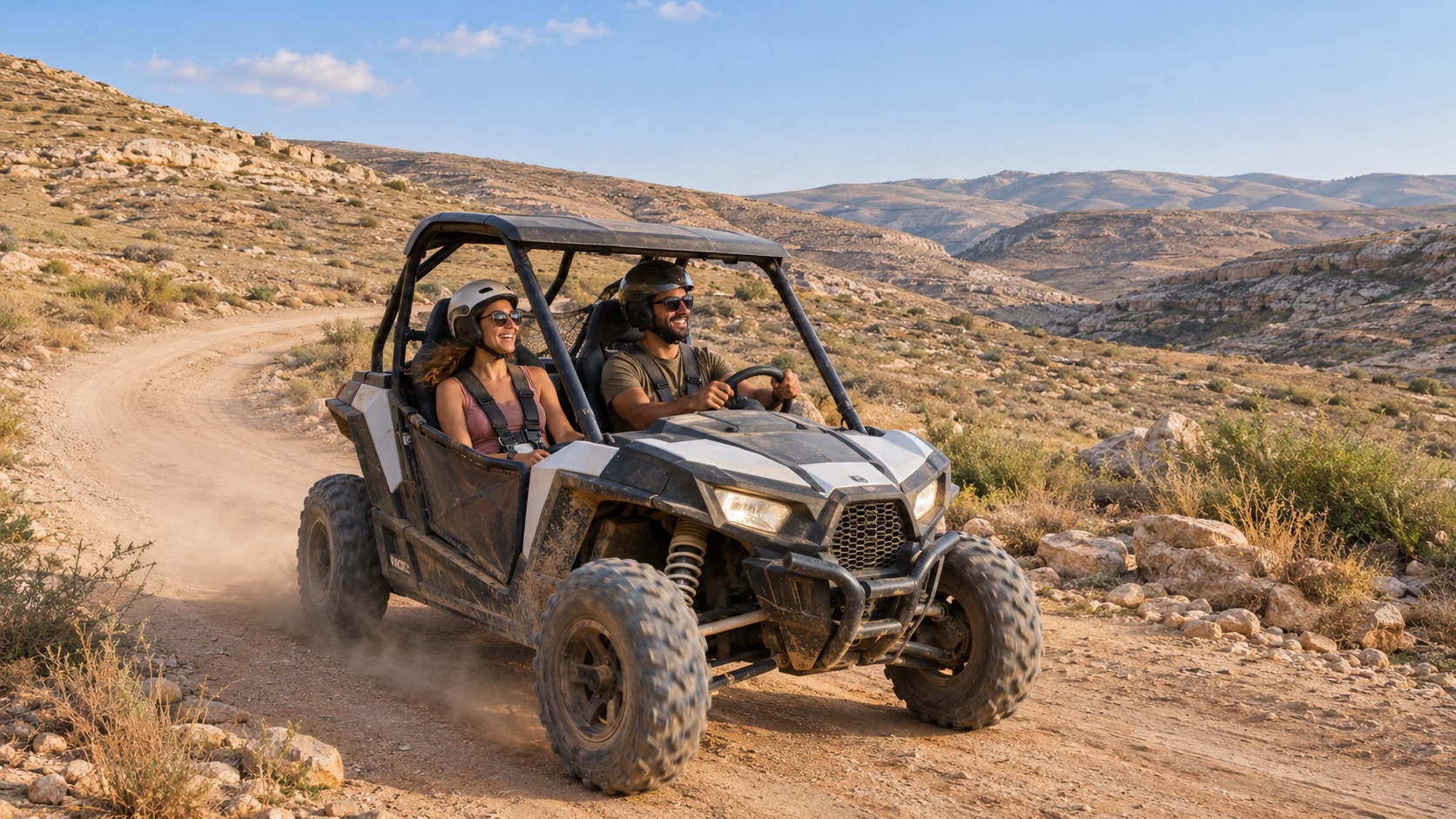
A bend in Nahal Shlomo opens onto another stretch of the Eilat Mountains. At the wheel, you are watching the track; beside you, someone has time to take in the slopes. ATV tours in Israel bring those two experiences together, but the vehicle determines how you share them. A family in a four-seat RZR, friends riding individual machines and a passenger on a quad are taking part in different ways.
Start with an actual programme. RZR Eilat publishes guided self-drive outings lasting from one to four hours, with named routes through the mountain surroundings of Eilat. Camel Ranch offers EZRaider outings with a different riding position and its own participation rules. For buggy tours in Israel, compare these named routes and participation formats alongside the place you want to visit. Each operator sets its own programme conditions.
RZR Eilat lists lower and upper Nahal Shlomo and Nahal Rehavam, with climbs, descents and a refreshment pause.
The same operator lists a three-hour programme reaching named places around Nahal Roded, Shkhoret and Nahal Amram.
Camel Ranch describes EZRaider riding seated or standing. Its rules belong to that activity, separately from RZR driving.
2. ATV, buggy, RZR and EZRaider describe different choices
The category name covers several vehicles. A conventional quad-style ATV has a straddle seat and handlebars. A side-by-side has separate seats and steering-wheel controls; RZR is a name you will encounter in this part of the market. Buggy is also used broadly in activity listings. Ask to identify the exact vehicle rather than using any of those labels as a reliable description of capacity or eligibility.
At RZR Eilat, the operator states that its vehicles have four seats. Count the driver within those four places. A party with several people who want to drive needs to think about the allocation of vehicles and any authorised driver changes. Four seats describe how many people can sit in one vehicle; they do not promise that each person can take a turn at the controls.
EZRaider is a separate option at Camel Ranch. The ranch describes riding it either seated or standing and provides a short introduction before departure. The similar sound of EZRaider and RZR can be confusing when comparing advertisements. For its EZRaider activity, the ranch states that a driving licence is unnecessary. RZR Eilat specifies a valid driving licence for self-drive participation.
| Format | How participation differs | What to identify |
|---|---|---|
| Quad-style ATV | Straddle-seat riding with handlebar controls | The exact machine and authorised rider/passenger arrangement |
| RZR at RZR Eilat | Shared vehicle with four seats in total | The driver, other occupants and any permitted changes |
| EZRaider at Camel Ranch | Seated or standing riding after an introduction | Individual eligibility and any child-passenger arrangement |
3. Guided self-drive puts you behind the wheel
RZR Eilat describes self-driving behind a guide. You control your vehicle while following the leader through the chosen programme. That arrangement gives a first-time participant a useful point of reference: there is an organised route and someone leading it. It also means the outing has a group rhythm. Choose this format for the experience of driving through the setting with guidance, rather than expecting to select turns independently.
Before moving, understand the controls and the instructions for following the leader. Ask how the guide signals a stop and what to do if you lose contact with the vehicle ahead. During the drive, give your attention to the surface and the required spacing. Use an authorised stop for photographs. These are practical priorities for taking part; the briefing for the exact machine remains the instruction to follow.
Passengers have a different role. They can follow the changing shape of a valley or notice the next mountain face while the driver concentrates on the track. Stops bring the group back together for a drink and a look around. When choosing a programme, give the passengers a voice: someone who enjoys the scenery may still prefer a shorter period of movement over rough ground. Driving enthusiasm in one seat does not tell you what everyone else will enjoy.
4. An hour through Nahal Shlomo and Nahal Rehavam
RZR Eilat names the Camel Ranch, lower Nahal Shlomo, Nahal Rehavam and upper Nahal Shlomo in its one-hour programme. The route description explicitly mentions climbs and descents. That makes the short option a useful example of why duration and driving character should be considered separately. A compact outing can still involve changes in gradient; an hour is a time label rather than a measure of smoothness.
This keeps the outing focused on the Nahal Shlomo area. The longer Shkhoret and Amram programme has a wider itinerary, so compare it if seeing more places matters to your party. For a first shared RZR experience, the shorter route offers a compact mountain outing. Its climbs and descents are still worth discussing if anyone is concerned about slopes or jolts.
The published one-hour description includes a break with cold water, tea and coffee. Treat that as part of this particular programme. It also explains why advertised tour duration should be distinguished from uninterrupted time at the wheel. The pause gives passengers time to stand still and look at the surroundings; it is one element of the outing, alongside the driving itself.
5. The ninety-minute option adds the old Eilat road and Mount Yoash
The ninety-minute RZR Eilat itinerary keeps lower Nahal Shlomo, Nahal Rehavam and upper Nahal Shlomo, then names the old road to Eilat and Mount Yoash. Its description also mentions climbs and descents and a break with cold water, tea and coffee. Compared with the hour-long option, you have named additions to consider rather than an unexplained increase in duration.
The old road adds a human trace to the mountain setting. It offers a natural subject for conversation with the guide about the routes connecting Eilat with its surroundings. Alongside Mount Yoash, it gives this programme a different focus from the shorter valley itinerary. Choose it if those additions interest you, while leaving time at the stops to look beyond the vehicle.
For a couple, the ninety-minute programme may be worth comparing with the shorter drive if both want more of the mountain setting. A family should weigh that extra time against the interest of the passengers for the ride. The useful comparison is the added old-road and Mount Yoash element, together with the longer period outdoors. It does not establish more personal driving time for every member of a shared vehicle.
6. Longer Eilat routes reach Roded, Shkhoret and Amram
RZR Eilat describes its three-hour outing as a private trip. The detailed programme lists the ranch, a quarry and the pipeline road, then Nahal Shahmon, the Nahal Netafim overnight campsite and upper Nahal Roded. It continues with Shkhoret Canyon, Nahal Amram and the Amram Pillars. This is a broader set of places than the short Nahal Shlomo programme, with a different scope for a desert day.
Follow the itinerary with the operator rather than trying to connect these places independently. A canyon or a formation appearing in a route description does not tell you the precise stopping point or how much walking is involved. The campsite in the list is a named place on the programme; the three-hour trip is not advertised as an overnight stay. Distinguishing a route landmark from an included activity keeps the plan realistic.
The three-hour page mentions climbs and descents and a break with drinks, fruit, tea and coffee. Its longer duration therefore covers an outing with a pause, rather than a promise of three uninterrupted hours of driving. If your interest is in seeing a wider spread of the Eilat Mountains, the place list gives a meaningful reason to consider it. If the group mainly wants a first taste of the vehicle, the short programme already has a defined mountain route.
The operator also publishes a four-hour option whose overview names Maale Ora and a hidden lake alongside Roded, Shkhoret and Amram. A water-related place name should not be read as a swimming inclusion or a guarantee about water conditions. Compare the longer option for its stated route and total time outdoors. Settle the actual itinerary with the organiser, since access and conditions belong to the departure being offered.
7. EZRaider at Camel Ranch changes the way you ride
Camel Ranch describes EZRaider outings lasting about seventy-five to ninety minutes, led by a qualified leader familiar with the route. The vehicle can be ridden seated or standing. That gives it a different participation style from travelling with the family in a four-seat RZR. Someone comparing the two should picture their own position on the vehicle as carefully as the desert backdrop.
The ranch states that riders do not need a driving licence and receive a short introduction before setting out. It gives sixteen as the minimum age for independent participation. Those conditions make the activity relevant to some people who would not meet the normal RZR Eilat driving requirements. They remain rules of this specific EZRaider programme, rather than a general exemption for ATV or buggy driving in Israel.
The ranch also offers privately arranged EZRaider outings tailored to group preferences. This can be useful for friends who want the same riding format and would like to discuss their own group plan. Tailoring describes an arrangement to agree with the organiser; it does not establish unrestricted route choice. Keep the comparison focused on who rides, the planned duration and the degree of privacy you are actually buying.
For this activity, Camel Ranch specifies comfortable clothing and closed shoes, with walking or sports shoes preferred. Hair must be tied back, and helmets and protective equipment supplied at the ranch must be worn. The ranch says the activity is unsuitable during pregnancy or for people with back problems. These restrictions deserve more weight in the decision than promotional language about excitement or stability.
8. Family arrangements begin with each person in the vehicle
For family buggy tours, separate the driver requirements from the passenger requirements. RZR Eilat publishes a normal driving threshold of twenty-three with a valid licence. Its FAQ also mentions an under-twenty-three exception when parents join the trip or give telephone permission. This is an operator policy to resolve directly for the individual driver, not a national legal rule or an automatic entitlement to drive.
The same FAQ states a minimum participation age of three and four seats per vehicle. The main description mentions child safety seats. Those statements provide a starting point for a family discussion, but the exact seating arrangement still has to fit the child. Give the organiser the actual ages and needs of your party. A minimum age and an available seat are separate pieces of information.
Camel Ranch publishes a different child-passenger arrangement for EZRaider, available at an additional charge. The child must weigh up to forty kilograms and measure up to 1.10 metres. The combined load must stay within 130 kilograms per vehicle. All those conditions belong together. The sixteen-year threshold for independent participation describes another role. Avoid taking one convenient figure from either programme and applying it to a different machine.
The official Eilat tourism portal describes Desert ATV programmes of one, two or four hours. In its listing, children and teenagers travel as passengers rather than drivers, and two guides accompany the tour. The portal also describes a refreshment stop. Obtain confirmation from the company of the arrangement being sold before relying on the listing for a family plan.
9. Match the regional idea to a named route
For a northern holiday, the Galilee and Golan may be the regions you want to explore. For a stay in Eilat, Nahal Shlomo or the longer Shkhoret and Amram programme offers a specific southern starting point. Choose the region that belongs naturally in your trip, then look at what the individual programme actually does there. A regional name gives you a search area; the itinerary tells you how the outing will unfold.
The southern examples here show why nearby names should be kept separate. RZR Eilat lists Nahal Shlomo in the short programme and Shkhoret and Amram in the longer one. That does not establish a visit to Timna, a drive through the whole Arava or a Red Sea swim. A familiar attraction elsewhere around Eilat should have its own place in the day unless it is explicitly part of the booked itinerary.
For a Galilee or Golan outing, apply the same level of detail: a named departure point, the exact vehicle and a programme description that goes beyond northern views. Use the Eilat programmes as a comparison of formats, then read the conditions from the northern provider on their own terms. Driving eligibility, seating and stops all belong to the offer you choose.
10. Compare the full-party cost and the damage terms
A price for a vehicle and a price for an individual place answer different questions. With four seats in the RZR Eilat vehicles, establish who occupies each vehicle and which people are authorised to drive. With EZRaider, account for the individual riding arrangement and any separately charged child passenger. Ask for one total for the actual group so that the comparison reflects the way everyone will participate.
RZR Eilat invites visitors to request a quotation rather than supplying a numeric tariff on the programme pages used here. Camel Ranch describes an extra charge for the eligible EZRaider child passenger without stating the amount on that activity page. Request a written quote identifying the vehicle, duration and inclusions. It should state the amount for your whole party, including any eligible child passenger.
| Cost element | Useful comparison | Keep separate |
|---|---|---|
| Charging unit | Whole-party total for the same people and roles | A vehicle price and a per-rider price |
| Programme | One-hour Shlomo route or a longer named itinerary | Advertised duration and uninterrupted driving |
| Inclusions | Refreshment break stated for the chosen programme | Features shown in another tour description |
| Liability | Deposit, damage terms and release conditions | The activity fee and possible damage obligations |
RZR Eilat describes a credit-card deposit for vehicle damage associated with careless driving or incorrect use. It separately refers to bodily-injury insurance. The brief website wording does not establish the full policy terms, the amount of the deposit or zero liability for participants. Read the rental and damage conditions before agreeing. Keep that potential obligation distinct from the cost of enjoying the tour itself.
11. Prepare for the physical ride and the briefing
Allow time to learn the machine before the outing begins. Camel Ranch asks EZRaider participants to arrive about fifteen minutes before the trip so they can attend the safety introduction. That is useful time at the start of the visit, separate from the published riding duration. For a RZR programme, follow the arrival and briefing instructions supplied with that booking rather than using the EZRaider arrival time.
An open-vehicle outing involves exposure to the outdoor conditions and movement over the route. Choose clothing you are comfortable wearing for that activity, and organise drinking water and sun protection according to the instructions from the organiser. Stow loose belongings before moving. Ask during the briefing where possessions go and which equipment must stay on. Keep your hands and attention available for driving.
Think about your passengers before committing to the longest programme. Someone who is uncertain about bumps can discuss the short route with the organiser, but a shorter duration does not guarantee a gentle surface. The one-hour RZR description itself includes climbs and descents. If a medical concern affects participation, seek appropriate advice and disclose the relevant issue to the provider rather than using the appearance of a seat as reassurance.
- Identify the exact vehicle and the role of every participant.
- Read the named route, including any planned refreshment pause.
- Resolve individual driving and child-seating requirements.
- Bring the clothing and equipment specified for that programme.
- Keep the total price, deposit and damage conditions in separate lines.
12. Build the rest of the day around the chosen outing
A one-hour Nahal Shlomo programme can be considered as one part of an Eilat day, while a three- or four-hour trip deserves a larger place in the plan. Include travel to the departure point, preparation and the return when arranging the next activity. Leave room to change out of dusty clothing and have a meal. The printed tour duration cannot cover every part of your visit.
For couples, discuss whether the attraction is sharing one vehicle or each having a driving role. For friends, a privately arranged outing may be worth comparing with a shared departure if it answers a specific group preference. Families can start with a vehicle and programme that fit the passengers, then choose the rest of the day around that decision. A longer place list adds little if half the party has stopped enjoying the ride.
Compare the Shlomo and Rehavam route with the Mount Yoash addition or the longer Roded and Amram outing. If a seated or standing ride appeals, consider the distinct EZRaider format. They give you concrete differences to weigh. Keep accommodation separate unless an offer explicitly combines it with the activity, and retain the written itinerary and participation conditions with your booking details.